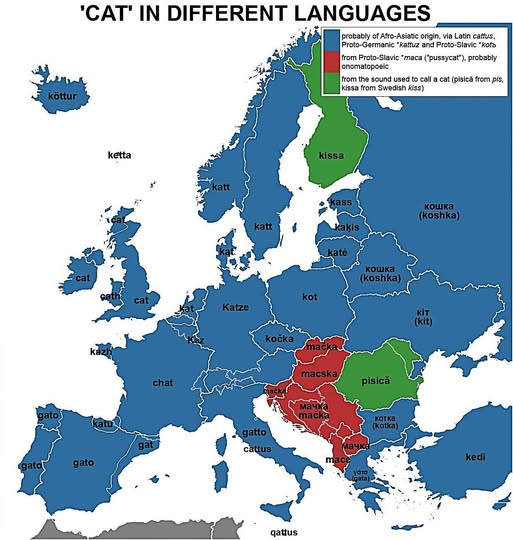
Map found on Reddit
If you have ever wondered why the French say chat, the Spanish say gato, and the Finns say kissa, you are not alone.
This brilliant little map of Europe reveals something surprisingly deep about human history, trade routes, and the quirky ways language evolves over thousands of years.
The Big Blue Block: Latin Did the Heavy Lifting
The overwhelming majority of European countries use a word rooted in the Latin cattus, which itself likely came from an Afro-Asiatic origin and fed into Proto-Germanic and Proto-Slavic branches.
This is why English speakers say “cat,” Germans say “Katze,” Russians say “кошка” (koshka), and Italians say “gatto.” These words all trace back to the same ancient root, carried westward and northward as domestic cats spread through Roman trade networks.
Pretty remarkable that a word can survive two millennia largely intact.
The Red Zone: Slavic “Maca” Country
A striking red cluster sits in the western Balkans, covering parts of the former Yugoslavia. Here, the word for cat derives from the Proto-Slavic maca, meaning roughly “pussycat.”
Serbia, Croatia, and neighbouring areas use variations like mačka and мачка. It is a warmer, softer-sounding word, and linguists believe it likely developed independently within that regional Slavic family rather than being borrowed from outside.
Finland Stands Alone in Green
Finland is the real outlier on this map. The Finnish word kissa comes not from Latin, not from Slavic roots, but from the sound humans make to call a cat. Think of the “psss psss” or “kiss kiss” noise you make when trying to get a cat’s attention.
Finnish, which belongs to a completely separate language family from most of Europe (Finno-Ugric rather than Indo-European), simply built its word from that universal human cat-calling sound. Wonderfully logical, honestly.
Romania’s Surprise: “Pisică”
Romania stands out in green too, using pisică, which also derives from the sound used to call cats (related to the pis sound).
Despite being surrounded by Slavic- and Latin-influenced neighbours, Romanian developed this onomatopoeic path independently. Language does what it wants.
What This Map Really Tells Us
Beyond being a fun piece of trivia, this map is a quiet portrait of how ancient migrations, empires, and everyday human habits shape the words we use without us ever noticing. Next time your cat completely ignores you regardless of what language you call it in, just know: linguists across 40 countries share your pain.
Help us out by sharing this map: