Map found here
Europe is quietly undergoing one of its most dramatic demographic reshuffles in modern history.
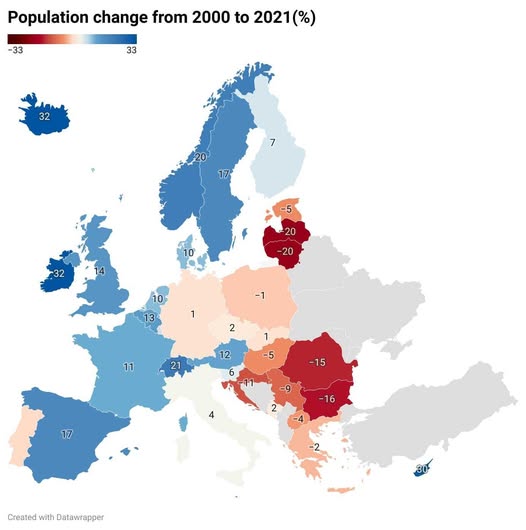
A map tracking population change between 2000 and 2021 tells a vivid story, painted in shades of red and blue, and the patterns are striking once you know what you’re looking at.
The Winners: West and North Are Booming
The blue end of the spectrum signals growth, and it’s concentrated in some predictable, and some surprising, places. Ireland leads the charge with a remarkable 32% increase, matching Iceland in the top spot. Luxembourg clocks in at 21%, driven largely by its status as a financial hub attracting workers from across the continent.
The Nordic countries, France, and the UK are all comfortably in positive territory, buoyed by a combination of immigration, relatively healthy birth rates, and strong economies pulling people in.
Spain, despite some turbulent economic years in the 2010s, still managed a 17% rise. These Western nations have generally benefited from being destinations rather than departure points.
The Losers: Eastern Europe’s Quiet Crisis
Here’s where it gets sobering. The deep reds across the eastern part of the map represent some genuinely alarming declines. Latvia and Lithuania have each shed around 20% of their populations since 2000. That’s not a rounding error; that’s roughly one in five people gone. Bulgaria sits at 16% down, Romania at 15%.
The causes are layered. Emigration to wealthier EU countries accelerated after 2004 accession, young people left in search of opportunity, and birth rates in many of these nations have been chronically low for decades. The result is a compounding problem: fewer young people means fewer future births, which means the trend is self-reinforcing.
The Middle Ground
Countries like Germany, Austria, and the Czech Republic hover in modest positive territory, reflecting immigration inflows that have helped offset demographic stagnation.
Poland, interestingly, sits near zero, having both sent large numbers abroad and received some in return.
Why Should You Care?
Population change is a slow-motion force that reshapes everything: housing markets, pension systems, school rolls, tax bases, and political power. The countries that are bleeding population now will face enormous pressure on public services in the coming decades, while the growers face their own challenges around infrastructure and integration.
This map is essentially a preview of Europe’s future tensions. The continent is not shrinking overall, but it is redistributing itself in ways that policymakers are only beginning to grapple with seriously.
The numbers are stark. The trends are already baked in. And the policy responses remain, in most places, frustratingly inadequate.
Help us out by sharing this map: