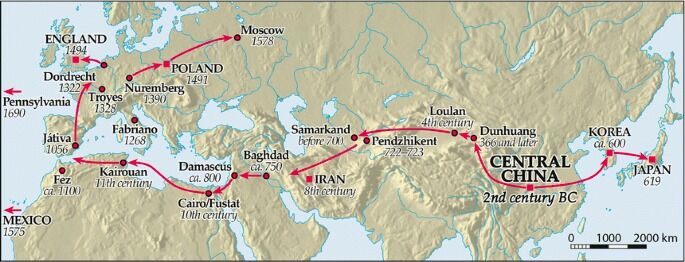
Map found on Reddit
Most of us grab a notepad or printer sheet without a second thought. But the story of how paper reached your hands is genuinely one of history’s great adventures, spanning nearly two thousand years and crossing almost every major civilisation on Earth.
This map tells that story beautifully. It traces the spread of papermaking outward from Central China, where it was invented around the 2nd century BC, rippling westward and eventually reaching every corner of the known world.
The Long March West
China kept its papermaking secrets close for centuries. It was not until around 619 AD that Korea adopted the craft, with Japan following almost simultaneously. From there, the knowledge crept steadily westward along the great trade corridors of the ancient world.
By the 8th century, Iran had learned the technique, and Baghdad was producing paper by around 750 AD. Cairo and Fustat picked it up in the 10th century, and the Arab world became a crucial relay station, passing the knowledge onward into North Africa and Europe.
Paper Hits Europe
This is where things get really interesting. The Spanish city of Játiva (now Xàtiva) became Europe’s first papermaking hub around 1056, followed by Fez in Morocco around 1100. From there, the craft spread north with remarkable speed.
Fabriano in Italy, still famous for fine paper today, was producing sheets by 1268. Troyes in France followed in 1348, Nuremberg in 1390, and England finally joined the club in 1494. By the time paper reached Pennsylvania in 1690 and Mexico in 1575, it had completed a journey that encircled virtually the entire Northern Hemisphere.
Why Does This Matter?
Paper is not just a writing surface. Wherever it arrived, it accelerated everything: trade records, religious texts, legal documents, scientific ideas, and eventually the printing press. The Protestant Reformation, the Scientific Revolution, and the explosion of literacy across Europe were all downstream consequences of this quiet, extraordinary migration of a single technology.
The Bigger Picture
What this map really shows is that great ideas do not respect borders. They travel along rivers of commerce, conflict, and curiosity, picked up and passed on by merchants, scholars, and monks who probably had no idea they were changing history.
Next time you scribble on a Post-it note, spare a thought for the long, winding road that humble sheet of paper took to reach you. It started somewhere in ancient China, and it took the entire connected world to bring it to your fingertips.
Help us out by sharing this map: