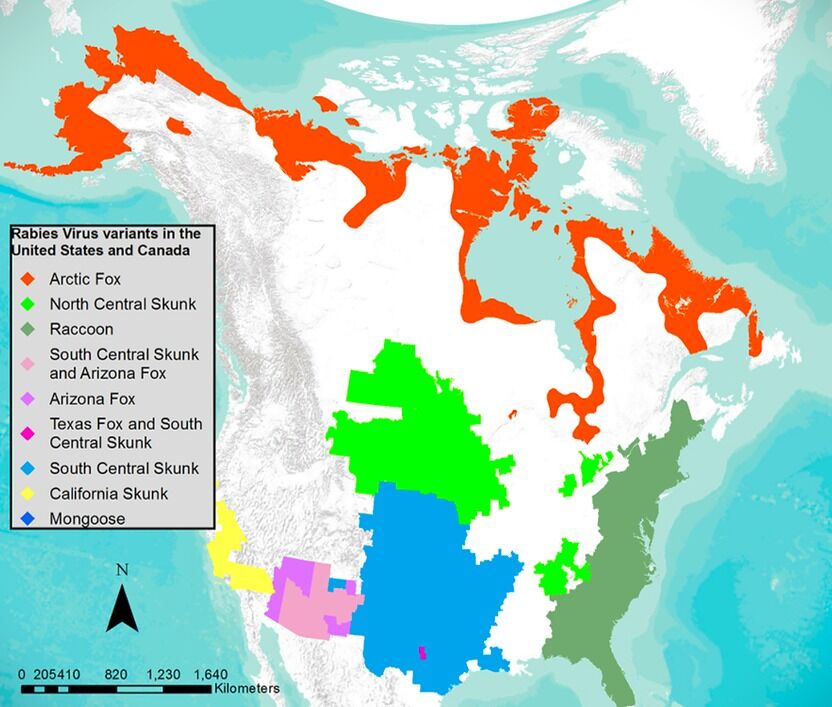
Map from PLOS Neglected Tropical Diseases
If you’ve ever assumed rabies is just “a rabies thing,” this map might surprise you. The rabies virus across North America isn’t one uniform threat, but it exists as distinct regional variants, each associated with specific wildlife hosts. Understanding where these variants live can genuinely help you stay safe outdoors.
The Big Orange Blob Up North
That sweeping orange coverage across northern Canada and the Arctic? That’s the Arctic Fox variant, and it dominates the map by sheer geography. It sprawls across some of the most remote terrain on the continent, which partly explains why it doesn’t make headlines — human encounters are relatively rare. But for wildlife researchers and sled dog owners, it’s a very real concern.
The Eastern Seaboard’s Raccoon Problem
The dark green zone hugging the entire eastern United States belongs to the Raccoon variant. This is arguably the most relevant strain for most Americans, given how comfortable raccoons have become with suburban life. If you live east of the Mississippi and spot a raccoon acting strangely in daylight, this is the variant your local health department is thinking about.
A Patchwork of Skunk and Fox Variants in the Midwest and South
The central regions of the US tell a more complicated story. Bright green covers a large chunk of the Midwest, representing the North Central Skunk variant. Moving south, you encounter South Central Skunk, Texas Fox, and South Central Skunk, and even a small but notable patch for the Arizona Fox variant in the Southwest. These overlapping zones reflect how wildlife populations and migration have shaped viral evolution over centuries.
California and the West Coast
A small yellow patch along the California coast marks the California Skunk variant, geographically contained but worth knowing if you hike or camp in the region.
The Mongoose Variant (Yes, Really)
There’s a tiny diamond marker for a Mongoose variant, which actually relates to populations in Puerto Rico rather than the continental US. It’s a reminder that rabies management is genuinely a global challenge with local flavors.
So What Should You Actually Do With This Information?
Knowing your region’s dominant variant helps you understand which animals your local animal control prioritises for vaccination programs and surveillance. It also reinforces a simple rule: if a wild animal is behaving unusually — disoriented, aggressive, or active at odd hours — keep your distance and call your local wildlife authority.
Rabies is almost universally fatal once symptoms appear in humans, but it is also almost universally preventable with prompt post-exposure treatment. The map above is a great reminder that wildlife and public health are deeply connected, right in your own backyard.
Help us out by sharing this map: