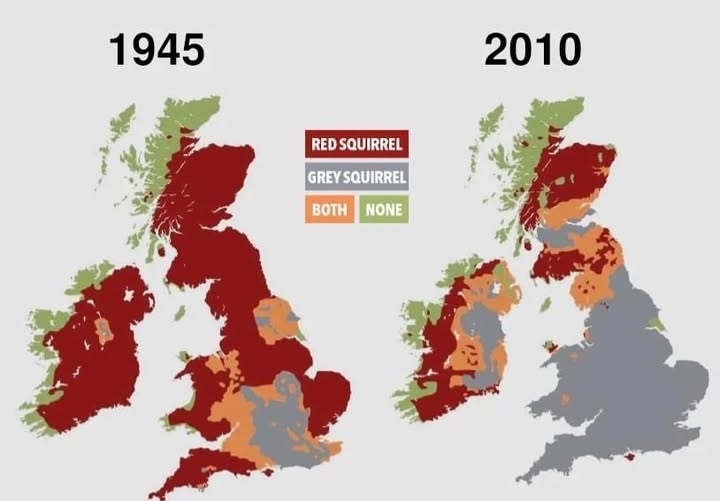
Map from the Red Squirrel Survival Trust
If you grew up in Britain, the red squirrel might feel like a national icon, the kind of creature that belongs on biscuit tins and children’s books.
But take one look at these two maps, and a sobering reality comes into focus: between 1945 and 2010, the red squirrel virtually disappeared from most of Britain.
What the Maps Are Telling Us
In 1945, red squirrels dominated the landscape. From the Scottish Highlands all the way down through England and across into Ireland, that rich dark red covered nearly everything.
Gray squirrels had already begun creeping in across parts of central and southern England, but the reds were still very much holding their ground.
Fast forward to 2010, and the picture is dramatically different. England is almost entirely gray, both in color on the map and in terms of which species lives there. The reds have been pushed back into refuges: northern Scotland, parts of Northern Ireland, and a few isolated pockets in northern England like Northumberland and the Lake District.
Why Did This Happen?
The gray squirrel is not a British native. It was introduced from North America in the 1870s, initially as a fashionable addition to country estates. Nobody anticipated what would follow.
Gray squirrels outcompete reds for food, particularly in broadleaf woodland. They are larger, more robust, and able to digest acorns that reds cannot process efficiently.
Crucially, they also carry squirrelpox virus, a disease that is harmless to grays but almost always fatal to red squirrels. Wherever gray squirrels arrive, red squirrel populations typically collapse within 15 to 20 years.
Is There Any Hope?
Actually, yes. Conservation efforts across Scotland, Northumberland, and Ireland have shown that targeted gray squirrel management, combined with habitat protection, can stabilise and even grow red squirrel populations.
The Red Squirrel Survival Trust and various wildlife organisations have been working hard on exactly this.
There is also growing interest in immunocontraception technology, essentially a bait that reduces gray squirrel fertility without harming other wildlife. It is not a silver bullet, but it represents a more scalable and humane approach than traditional culling.
Why Should We Care?
Beyond the obvious charm of the red squirrel, this story is a powerful example of how quickly human decisions, even well-meaning or simply careless ones, can reshape an entire ecosystem. The red squirrel took thousands of years to become part of Britain’s natural fabric. It took less than a century to push it to the edge.
The maps do not lie. But they also show us exactly where the fight is being won, and that is worth something.
Help us out by sharing this map: