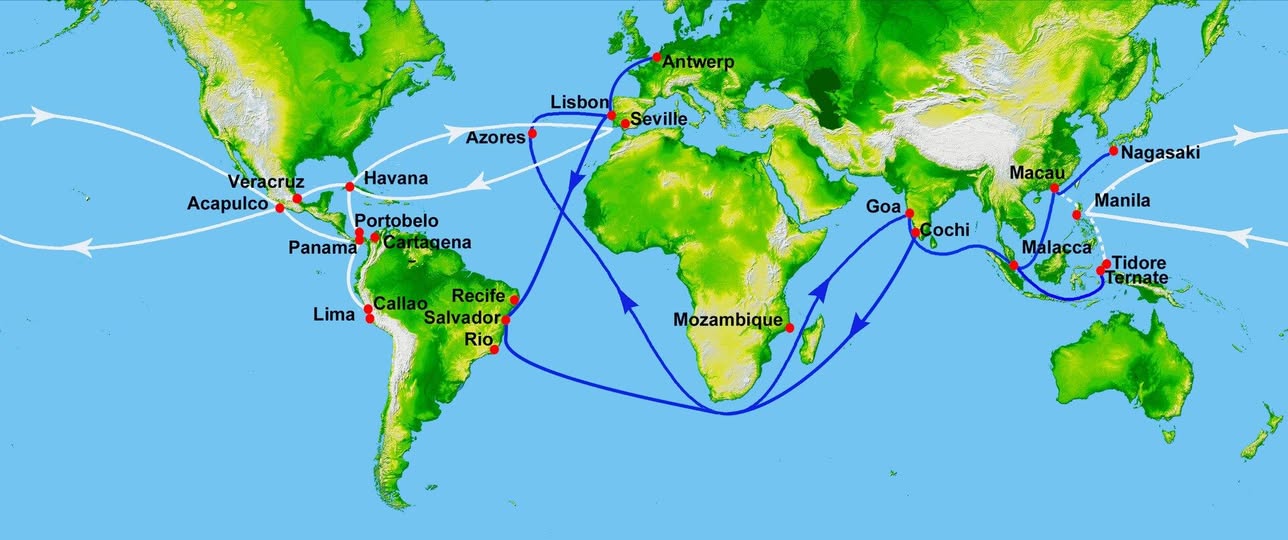
Map from Wikimedia Commons
Forget Silicon Valley. The first truly global network was launched not with fiber-optic cables but with wooden ships, monsoon winds, and an almost insane appetite for spices, silver, and silk. This map tells that story beautifully.
What you are looking at is the Iberian trade network at its peak, roughly the 16th and 17th centuries, when Spain and Portugal effectively divided the entire world between themselves and got very, very rich doing it.
Two Empires, Two Routes
The blue arrows trace Portugal’s eastern ambitions. Lisbon dispatched fleets south along the African coast, around the Cape of Good Hope, and onward to footholds at Mozambique, Goa, Cochi, Malacca, Macau, and the spice islands of Tidore and Ternate. This was the route that made black pepper worth its weight in gold back home.
The white arrows tell Spain’s story. Silver mined in the Andes flowed through Lima and Callao up to Portobelo and Cartagena, across to Havana, and then northeast on the Gulf Stream back to Seville. Meanwhile, a separate Pacific loop connected Acapulco to Manila in one of history’s great forgotten trade runs, the Manila Galleon route.
Why These Cities Mattered
Every red dot on this map was once a beating heart of global commerce. Seville held a legal monopoly on all Spanish trade with the Americas. Antwerp became fabulously wealthy as the redistribution hub for goods arriving in Europe. Recife and Salvador in Brazil grew rich on sugar. Macau sat at the crossroads of Chinese, Japanese, and European commerce.
These were not backwaters. At their height, many of these cities were among the wealthiest and most cosmopolitan on earth.
The Bigger Picture
What makes this map genuinely mind-bending is the scale of coordination it represents, centuries before telegraphs, telephones, or containerized shipping.
Merchants in Seville were making financial bets on cargo sitting in a warehouse in Goa. Silver from Potosi in modern Bolivia was ending up in Chinese markets because the Ming Dynasty had a chronic shortage of it.
The world did not become interconnected in the 20th century. It became interconnected here, in the age of sail, driven by profit, ambition, and occasionally extraordinary courage.
Worth Remembering
Next time someone talks about globalization as though it began with Amazon Prime, share this map. The supply chain anxiety, the currency fluctuations, the geopolitical tensions over trade chokepoints, it was all here first, just with better hats.
Help us out by sharing this map: