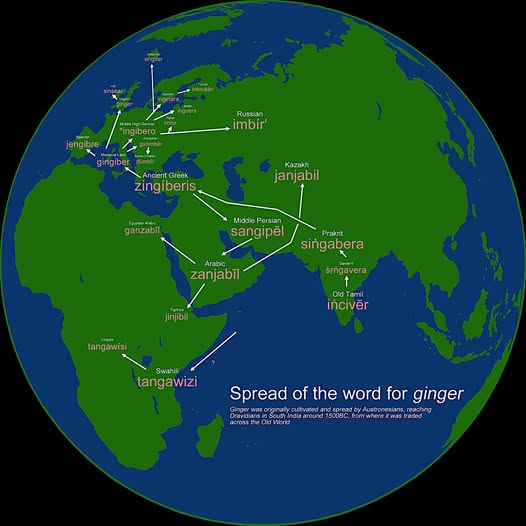
Map found on Reddit
Few ingredients have travelled as far, fed as many cultures, or left such a clear linguistic fingerprint as ginger.
This fascinating map traces how a single spice gave birth to remarkably similar words across dozens of languages, from the steamy coasts of South India all the way to the windswept markets of East Africa and medieval Europe.
It All Started in South India
Ginger was originally cultivated and spread by Austronesians, but it was the Dravidian peoples of South India who gave the world its name for the spice around 1500 BC.
The Old Tamil word inciver and the Sanskrit srngavera sit at the heart of this story, acting as the linguistic launching pad for everything that followed.
The Silk Road Did the Heavy Lifting
Once traders got hold of ginger, the word hitched a ride along ancient trade routes.
The Prakrit form singabera fed into Middle Persian sangipel, which in turn shaped the Arabic zanjabil. From Arabic, the word branched out beautifully: Swahili became tangawizi, Egyptian Arabic produced ganzabil, and Yemeni Arabic gave us jinjibil.
Meanwhile, the Ancient Greeks absorbed the word as zingiberis, which is arguably the most pivotal step of all. That Greek form became the root that flowered into nearly every European language we know today.
Europe Runs With It
Once zingiberis entered the Latin and Germanic bloodstream, it spread rapidly.
Middle High German transformed it into ingber, which nudged along into the Spanish jengibre and the instantly recognizable English ginger. Even the Russian language got in on the action with imbir. The family resemblance across all these words is striking once you see it laid out on a map like this.
Why This Map Is Worth a Long Look
What makes this visualization so compelling is that it does not just show geography. It shows time, trade, and human connection compressed into word shapes. Every variation in spelling reflects a real journey: a merchant crossing a desert, a sailor rounding a cape, a recipe shared between neighbors who did not even speak the same language.
The spice itself is remarkable enough. But the story of its name is a reminder that languages borrow, adapt, and carry history inside them in ways that no history book quite captures.
Next time you grate a knob of fresh ginger into a curry or a cocktail, you are using something that has been crossing borders for over three thousand years. And now you know the word for it has been doing exactly the same thing.
Help us out by sharing this map: