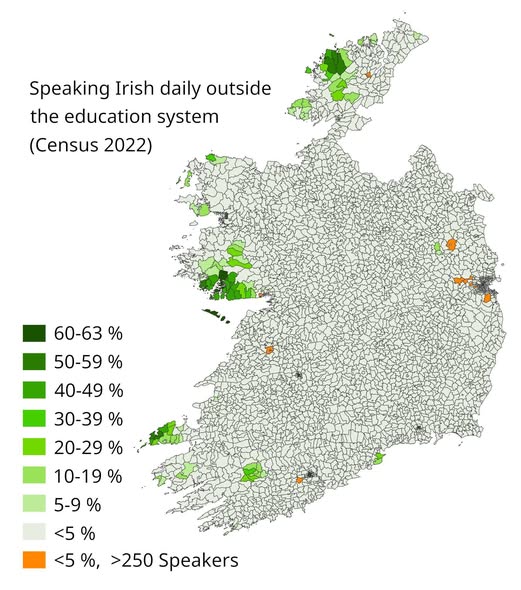
Map found on Reddit
If you glance at this map of Ireland from the 2022 Census, most of it looks pretty pale. Light greens and near whites dominate the midlands, the east, and the south.
But look closer at the western fringes and a few dark green patches leap out, and those patches tell a fascinating story about a language that refuses to disappear.
What the Map Is Actually Showing
This is not about who studied Irish in school. Every Irish person did that.
This map tracks something far more meaningful: people who speak Irish daily outside the education system. That means at home, at work, with friends, in the shop. Real, living use of the language in everyday life.
The colour scale runs from under 5% (almost white) up to 60 to 63% (deep forest green). Orange patches mark areas with fewer than 5% daily speakers but more than 250 actual speakers, which matters in urban contexts like Dublin and Cork.
The Gaeltacht Glows
The well-known Gaeltacht regions, those officially Irish-speaking areas along the western seaboard, are exactly where you see the deepest greens.
Connemara in Galway, Donegal in the northwest, and the Dingle Peninsula in Kerry all show concentrations of 40% and above. A handful of areas in Donegal reach that remarkable 60 to 63% band at the very top of the scale.
These are communities where Irish is genuinely the community language, passed down through families and used naturally day to day, not preserved behind glass in a classroom.
Urban Surprises in Orange
Those orange dots scattered around Dublin and a few other cities are quietly interesting. They represent areas where the percentage of daily speakers is low, but the raw number of speakers is significant, over 250 people.
Urban Irish speakers tend to be young, educated, and often connected to the revival movement through Irish medium schools and social groups. They are a small but energetic part of the picture.
Why This Matters
Language is culture in its most intimate form. Irish carries centuries of poetry, law, storytelling, and a way of seeing the world that simply does not translate word for word into English. Every person who uses it daily outside school is doing something genuinely countercultural in a country where English dominates every screen and billboard.
The 2022 Census does not paint a triumphant picture for the language overall. But those deep green western parishes, and the growing orange dots in our cities, suggest the language has a living core worth paying attention to.
It is not a museum piece just yet.
Help us out by sharing this map: