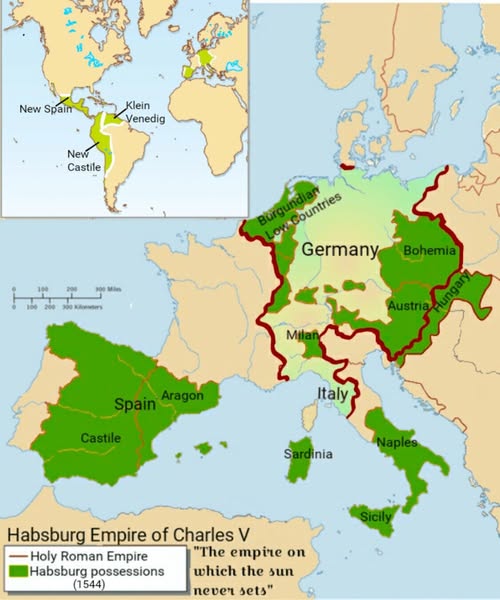
Map from Wikimedia Commons
If you think today’s geopolitical superpowers are impressive, wait until you meet Charles V.
In the 1500s, this one man presided over an empire so vast that his court literally coined the phrase “the empire on which the sun never sets.” The map above, showing his holdings in 1544, tells a story that still boggles the mind.
How Did One Person End Up With All This?
The short answer: inheritance, marriage, and extraordinary timing.
Charles was the grandson of both Ferdinand and Isabella of Spain and the Habsburg Holy Roman Emperor Maximilian I. By the time he was in his twenties, titles and territories were piling up like gifts at a royal birthday party.
He ended up holding:
In Europe: Spain (Castile and Aragon), the Burgundian Low Countries (modern Belgium and the Netherlands), the Holy Roman Empire covering most of Germany, Bohemia, Austria, Hungary, Milan, Naples, Sardinia, and Sicily.
Across the Atlantic: New Spain (Mexico and much of Central America), New Castile (Peru), and even a chunk of Venezuela called Klein Venedig, which translates directly as “Little Venice,” granted to German bankers as repayment for financing his election as Emperor.
The Red Line That Changed History
Notice the bold red border on the map marking the Holy Roman Empire.
That boundary mattered enormously because the Empire was not a unified kingdom like Spain. It was a patchwork of princes, bishops, and free cities that Charles was constantly trying to manage, negotiate with, and occasionally fight.
Martin Luther launched the Protestant Reformation right inside this territory in 1517, and Charles spent decades wrestling with the fallout.
Why This Still Matters
The Habsburg era essentially built the blueprint for early globalization.
Spanish silver from the Americas flooded European markets, rewiring trade and triggering inflation across the continent. Administrative models developed under Charles influenced how colonial bureaucracies were structured for centuries.
The tension between centralized imperial ambition and local political resistance that Charles faced daily in Germany? You can draw a fairly straight line from that to modern debates about sovereignty, federalism, and supranational governance in Europe right now.
A Man Exhausted by His Own Empire
Fascinatingly, Charles voluntarily abdicated in 1556, splitting his empire between his son Philip II (who got Spain and the overseas territories) and his brother Ferdinand (who got the Holy Roman Empire). He retired to a monastery in Spain and reportedly spent his final years tinkering with clocks. After managing the complexity visible on that map, perhaps he had earned the quiet.
Few figures in history held so many levers of global power simultaneously, and fewer still walked away from all of it by choice.
Help us out by sharing this map: