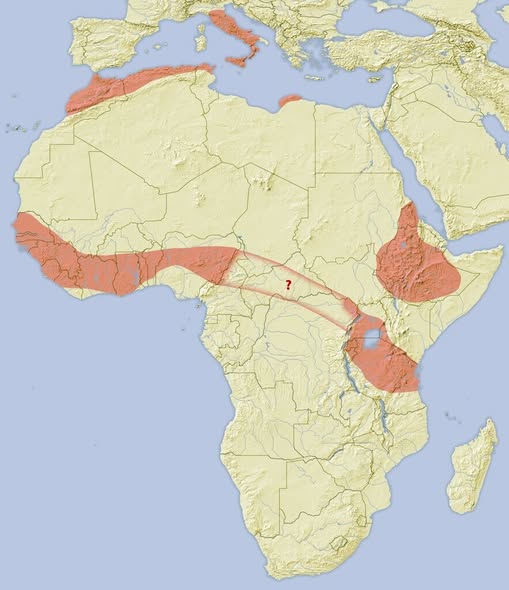
Map from Wikimedia Commons
At first glance, you might assume the African crested porcupine (Hystrix cristata) lives, well, in Africa. And you would be right.
But look more carefully at that shading on the map and something jumps out immediately: it also covers a substantial chunk of North Africa and Italy. Yes, Italy.
A large, spiky African rodent has been happily living on the Italian peninsula for centuries, making it one of the more unexpected wildlife stories in Europe.
Reading the Map: A Band Across the Continent
The range sweeps in a broad diagonal band from West Africa eastward through the Sahel, then curves down through Ethiopia and the East African Rift system.
What is immediately striking is what the range avoids: the dense Congo Basin rainforest in central Africa is almost entirely absent from the orange shading.
This is not a jungle animal. The crested porcupine prefers rocky hillsides, open woodland, and scrubby savanna where it can forage for roots, bulbs, and bark without too much competition.
The question mark sitting in the middle of the map, somewhere over South Sudan and the Central African Republic, is a refreshingly honest touch from the mapmaker.
In short, we are not entirely sure whether they live there or not. For an animal covered in 35 cm (0.38 yd) quills, it remains surprisingly understudied in parts of its range.
The Italy Situation
The North African and Italian populations are genuinely intriguing.
Crested porcupines are not native to Europe in the modern sense; the Italian population is thought to descend from animals introduced by the Romans, possibly as a food source, and they have been quietly thriving on the peninsula ever since.
Today, they are the only wild porcupine species in Europe, living in rocky terrain across much of central and southern Italy. Farmers are not always delighted about this.
Built for Survival
Part of the reason this species occupies such a wide and varied range is that it is extraordinarily adaptable. Crested porcupines are largely nocturnal, highly secretive, and capable of living at elevations up to 3,500 meters (11,482 feet).
Their quills, which are modified hairs rather than needles, are not fired like cartoon porcupines suggest; instead, they detach on contact and work their way painfully into a predator’s flesh.
Lions have learned to avoid them. Most things have.
A Poorly Understood Giant
At up to 27 kg (59 lb), the African crested porcupine is the largest rodent in Africa and one of the largest in the world. Yet outside of specialist circles, it rarely gets the attention it deserves. That diagonal sweep of orange across the map, stretching from Senegal to Sicily, is the quiet signature of an animal that has been getting on with things, largely unbothered, for a very long time.
Help us out by sharing this map: