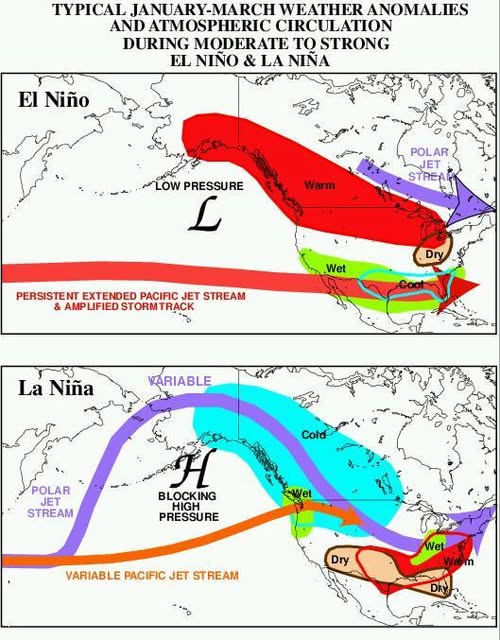
Map by the US NOAA/Wikimedia Commons (Public domain)
If you’ve ever wondered why some winters bring endless rain while others serve up bitter cold and drought, the answer often traces back to a battle playing out thousands of miles away in the Pacific Ocean.
El Niño and La Niña are the two main phases of a climate cycle that reshapes North American weather from January through March every time they show up.
What El Niño Does to Your Weather
During a moderate to strong El Niño, a persistent, extended Pacific jet stream powers straight across the southern United States like a firehose. This supercharged storm track brings warmer-than-normal temperatures across the northern half of the country and unusually wet conditions across the South and parts of the Gulf Coast.
Meanwhile, the polar jet stream gets pushed northward, which is why the Pacific Northwest and parts of the Northeast tend to stay surprisingly dry and cool rather than buried in snow. If you live in the southern tier of the US, El Niño winters often mean flooding rains and active severe weather seasons.
What La Niña Flips Around
La Niña is essentially the opposite story. A blocking high-pressure system parks itself over the Pacific, forcing the polar jet stream on a wild, variable ride deep into the continent.
The northern US and Canada get bitterly cold. The Pacific Northwest turns wet, while the South and Southwest bake in dry conditions.
Interestingly, parts of the Southeast can still see above-normal warmth and even wet spells, depending on how the pattern sets up in a given year.
Why This Matters Beyond the Weather App
Most people check a seven-day forecast and call it a day. But understanding El Niño and La Niña gives you a genuine three-month outlook on what is coming.
That matters enormously for homeowners thinking about frozen pipes, farmers planning crop rotations, and anyone managing water resources in drought-prone regions.
Insurance companies, energy providers, and city planners all watch these patterns closely, and there is no reason the average person cannot benefit from the same big picture thinking.
The Bottom Line
These two climate patterns are among the most powerful and predictable seasonal influences on North American weather. They do not guarantee a specific outcome for your backyard, but they dramatically shift the odds in one direction or another. Next time a meteorologist mentions El Niño or La Niña, you will know exactly which way the atmosphere is leaning and why your winter is playing out the way it is.
Keep an eye on NOAA seasonal outlooks each fall. They will tell you which phase we are heading into and help you plan accordingly.
Help us out by sharing this map: