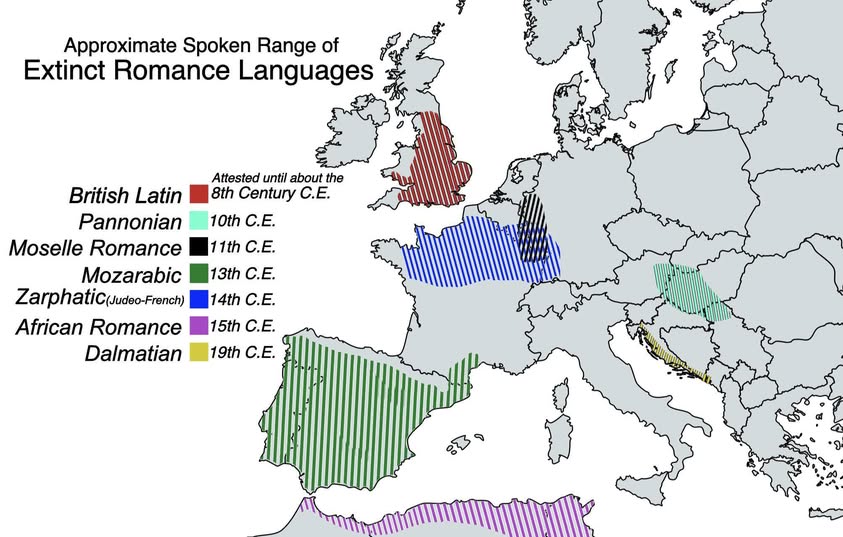
Map found on Reddit
You probably know French, Spanish, Italian, and Portuguese as the big survivors of the Latin family tree.
But Latin did not simply evolve into those few tidy modern languages. It splintered into dozens of regional dialects across the Roman Empire, and many of them lived, thrived, and quietly died long before anyone thought to write them down properly.
This map shows exactly where those forgotten voices once echoed.
What Even Is a Romance Language?
Romance languages are the direct descendants of Vulgar Latin, the everyday spoken version of the language that Roman soldiers, traders, and settlers carried across Europe and North Africa.
When the empire fragmented, so did the Latin people spoke, branching into wildly different local flavors depending on geography, neighboring cultures, and political upheaval.
The Languages on the Map
British Latin is perhaps the most poignant entry. Romans occupied much of Britain for nearly four centuries, and a Latin-rooted vernacular took hold there. When Roman administration collapsed and the Anglo-Saxon migration swept in, it was effectively gone by around the 8th century.
Pannonian, spoken in the region of modern Hungary and neighboring areas, hung on until roughly the 10th century before being absorbed by Hungarian and Slavic influences.
Moselle Romance thrived in the wine country along the Moselle River in what is now Germany and Luxembourg, lasting until the 11th century before German dialects swallowed it whole.
Mozarabic is a genuinely fascinating case: a Romance language that developed under Moorish rule in the Iberian Peninsula, blending Latin roots with Arabic influence. It survived until the 13th century as the Reconquista reshaped the region.
Zarphatic, also called Judeo-French, was spoken by Jewish communities in northern France and the Rhineland. It carried on until about the 14th century, its decline tied closely to persecution and expulsion of Jewish populations from France.
African Romance stretched across the North African coast, a remnant of Roman Carthage and its surroundings. It persisted until roughly the 15th century, gradually replaced by Arabic following the Islamic conquests.
Dalmatian is the most recently extinct of the group, surviving on the Dalmatian coast of modern Croatia all the way into the 19th century. The last known fluent speaker, Antonio Udina, died in 1898 in an explosion. A whole language, gone in an instant.
Why This Matters
These are not just historical curiosities. Each of these languages represents a community, a culture, and a way of making sense of the world. The map is a quiet reminder that language death is not ancient history; it has been happening continuously, and it is still happening today to hundreds of smaller languages globally.
History has a lot more voices than the ones we ended up keeping.
Help us out by sharing this map: