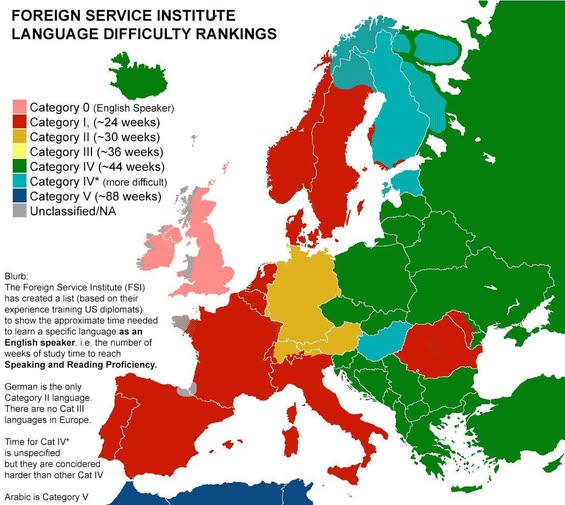
Map found on Flickr
If you have ever wondered why your Spanish colleague picked up English so fast, or why your Finnish friend still struggles after years of study, this map from the Foreign Service Institute (FSI) is about to make a lot of things click.
The FSI trains U.S. diplomats for overseas postings, which means they have spent decades figuring out exactly how long it takes an English speaker to reach solid speaking and reading proficiency in just about every language on Earth. Their findings, color-coded across Europe in the map above, are genuinely eye-opening.
Red Is Everywhere, and That Is Great News
The big red blob covering most of Western and Southern Europe represents Category I languages, languages that take roughly 24 weeks of intensive study to learn.
Spanish, Portuguese, Italian, French, Dutch, and the Scandinavian languages all sit in this friendly category. If you are an English speaker, these are your best bets for a relatively quick win.
Germany Gets Its Own Category
Interestingly, German stands alone in Category II at around 30 weeks. It is harder than French or Spanish, but not dramatically so. The grammar is trickier, and the cases take getting used to, but most learners find it very achievable.
The Further East You Go, the Harder It Gets
The teal and green shades spreading across Eastern Europe and the Balkans tell a more challenging story. Languages like Polish, Czech, Slovak, and Croatian fall into Category IV at roughly 44 weeks. The grammar structures, cases, and unfamiliar vocabulary all add up.
Then there is Finnish and Estonian, sitting in the cool blue of Category IV*, considered even harder than a standard Category IV language, with no set time estimate given. If you have ever tried Finnish, you already know why.
What About Those Gray Countries?
A handful of nations appear gray on the map, marked as unclassified or not applicable.
These are typically countries whose languages were not formally assessed in the FSI framework, or where the situation is more complex.
The Big Takeaway
This map is a genuinely useful reality check. It does not mean some languages are not worth learning; it simply means you should go in with honest expectations. Picking up Italian for a holiday is a very different project from mastering Hungarian for a job posting.
The FSI data is also a reminder that language learning is an investment, and like most investments, the returns compound beautifully over time. Start with a red country if you want momentum. Then, once you are hooked, maybe take a look at that teal.
Help us out by sharing this map: