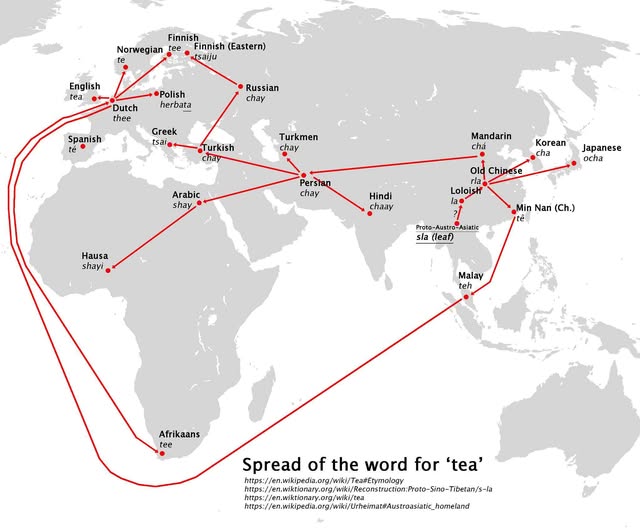
Map found on Reddit
Somewhere in ancient China, a word was born. And over centuries of trade, exploration, and empire, that word hitched rides on ships, camel caravans, and colonial routes until it landed in virtually every language on Earth.
The map above tells that story in a single glance, and it is genuinely fascinating.
Two Words, One Origin
Here is the surprising part: almost every language on the planet uses one of just two words for tea, cha or te, and both come from the same source, Old Chinese. The split happened because of geography and trade routes.
Languages that received tea overland, think Persian (chay), Russian (chay), Arabic (shay), Hindi (chaay), and Turkish (çay), borrowed the Mandarin pronunciation chá.
Languages that received it by sea, primarily via Dutch traders carrying the Min Nan Chinese word tê, ended up with variations of “te” or “tea.” That is why English says tea, Spanish says té, and Afrikaans says tee.
The Dutch Connection
The Dutch East India Company deserves enormous credit (or blame, depending on how you feel about colonialism) for spreading the “te” branch of the family tree.
Dutch traders picked up tea from the port of Amoy (modern Xiamen), where the local Min Nan dialect used tê, and carried it west to Europe. From there, it rippled outward to English, Spanish, and eventually all the way down to Afrikaans in southern Africa.
The Silk Road Carried the Other Half
Meanwhile, the overland Silk Road was busy doing the same thing in the opposite direction. Persian traders adopted chay, which then fed into Arabic, Turkmen, Greek, Polish (herbata is a notable outlier), and Russian.
Today, over 50 countries use some version of chai, which is why your local coffee shop’s “chai latte” is technically just a “tea latte.”
The Odd Ones Out
A handful of languages went their own way. Polish uses herbata, rooted in the Latin herba thea (tea herb).
Japanese uses ocha, with an honorific prefix attached. And Hausa in West Africa uses shayi, clearly borrowed via Arabic trade networks across the Sahara.
Why This Matters
This map is not just a quirky linguistics lesson. It is a visual record of how human civilisation connected itself through commerce and culture long before the internet, airlines, or smartphones existed. Every time you say “tea,” “chai,” or “teh,” you are speaking a word that has been traveling for over a thousand years.
That is a lot of history in a very small cup.
Help us out by sharing this map: