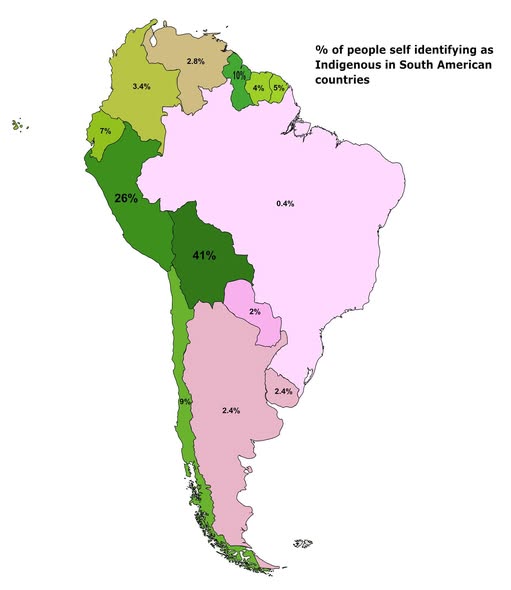
Map found on Reddit
If you scroll past maps every day without a second glance, this one is worth stopping for. It shows the percentage of people in each South American country who self-identify as Indigenous, and the variation across the continent is genuinely striking.
The Andean Heartland Leads the Way
The darkest greens on the map tell the most powerful story. Bolivia tops the chart at a remarkable 41%, making it the country with the highest proportion of Indigenous self-identification in all of South America. Right next door, Peru comes in at 26%. These figures reflect the enduring legacy of civilizations like the Inca, whose descendants never disappeared — they simply kept living, adapting, and identifying proudly with their heritage.
Ecuador, further north along the Andes, records 7%, which while lower, still represents a significant and politically active Indigenous population that has shaped national policy in recent decades.
The Middle of the Pack
Several countries sit in the low single digits. Colombia records 3.4%, Venezuela 2.8%, and both Argentina and Uruguay hover around 2.4%. These numbers are not tiny in absolute terms — Argentina alone has a population of over 45 million, so 2.4% represents well over a million people. Paraguay shows 2%, which is interesting given how culturally prominent the Guaraní language remains there, spoken by the majority of the population regardless of ethnic identity.
Brazil: Small Percentage, Enormous Scale
Brazil, the continent’s giant, sits at just 0.4% — the lowest on the map. That sounds modest, but Brazil is home to more uncontacted or recently contacted Indigenous groups than anywhere else on Earth. The Amazon basin shelters communities that have had little to no interaction with the outside world, making this number both an undercount and a reminder of how vast and complex the picture really is.
Why Self-Identification Matters
It is worth noting that all these figures are based on self-identification, not ancestry tests or government classification. That distinction matters enormously. In countries with a history of discrimination, many people with Indigenous roots may not identify as such publicly. In others, growing pride in Indigenous heritage has seen numbers rise over successive censuses. The data reflects culture, politics, and history as much as genetics.
The Bigger Picture
This map is a small window into one of the world’s most culturally rich continents. From the highlands of Bolivia to the forests of Brazil, Indigenous peoples represent living civilisations, not history book footnotes. Understanding where they are, and how they see themselves, is a good starting point for understanding South America at all.
Help us out by sharing this map: