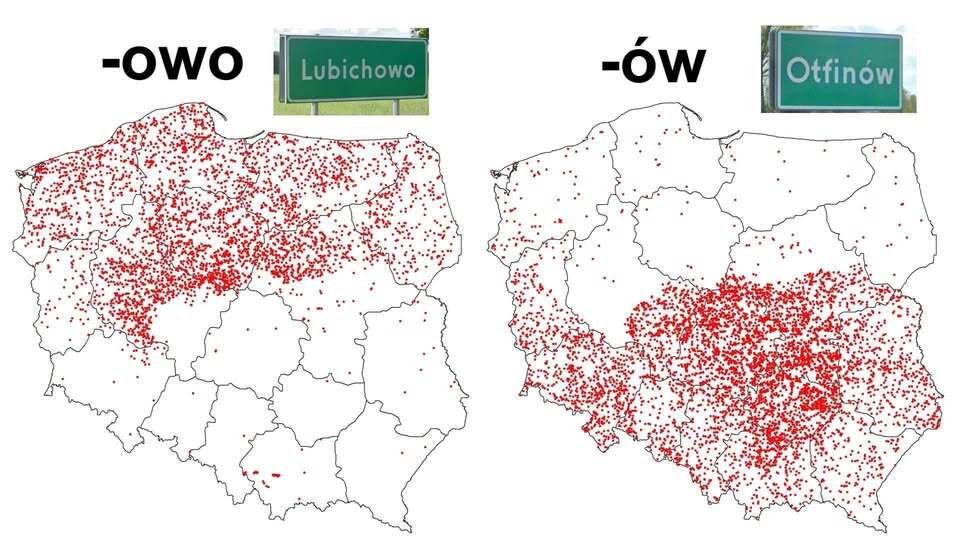
Map found on Reddit
If you’ve ever driven through Poland and noticed that town names seem to follow a pattern, you’re not imagining it. This fascinating pair of maps reveals one of the most visually striking examples of linguistic geography in Europe: the great Polish suffix divide.
The left map plots every settlement ending in owo (like Lubichowo), while the right tracks those ending in ów (like Otfinów). The dot density alone tells a vivid story.
North and West vs. South and East
The split is remarkably clean. The owo ending dominates the northern and western regions of Poland, clustering thickly across areas that were historically part of the old Piast heartland and, later, territories recovered from Germany after World War II.
Meanwhile, ów saturates the south and east, covering Lesser Poland, the Lublin uplands, and into the Subcarpathian region.
This isn’t random. Both suffixes share a common Slavic root indicating possession or association, essentially meaning “belonging to” or “place of.”
Wrocławowo would once have meant something like “Wrocław’s place.” But over centuries, regional dialects, administrative traditions, and settlement waves shaped which form took hold where.
Why Does This Happen?
Language doesn’t respect political borders, but it does respect time.
The owo form is associated with older western Slavic naming conventions, closely tied to the dialects that evolved in Greater Poland (Wielkopolska), the cradle of the Polish state. The ów form became dominant further east and south, shaped by different dialect zones and historical migration patterns.
When Poland’s borders shifted dramatically westward after 1945, and millions of Poles resettled formerly German lands, they brought naming conventions with them, reinforcing the owo concentration in the west.
What the Empty South Tells Us
Notice how the southern edge of both maps goes quiet near the Tatra Mountains and the Carpathian foothills.
That silence reflects something real: mountainous terrain historically supported fewer settlements, and those that existed often drew on entirely different naming traditions, sometimes Vlach (pastoral), sometimes Hungarian-influenced.
Place Names as Living History
Maps like these are a reminder that every road sign is a small fossil, preserving the speech habits, migration routes, and power structures of people who lived centuries ago. Poland’s suffix geography is essentially a snapshot of medieval settlement patterns, frozen into the landscape and refreshed every time someone has to paint a new town sign.
Next time you spot a Polish place name ending in owo or ów, you’ll know roughly where in the country you are, even without GPS.
Help us out by sharing this map: