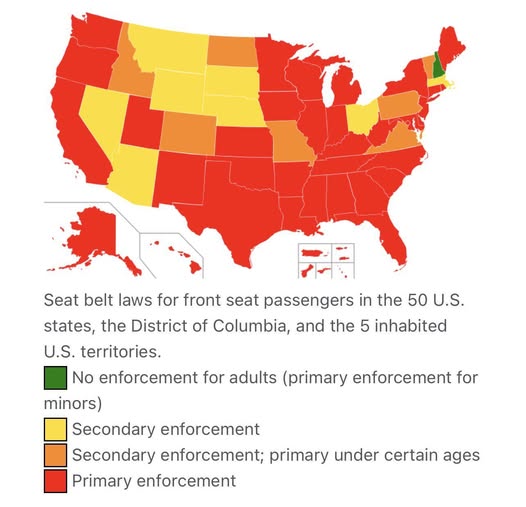
Map from Wikimedia Commons
If you assumed every state treated seat belts the same way, this map will surprise you.
A quick glance reveals a patchwork of rules that reflects how differently people in the United States feel about personal freedom versus public safety, and it has real consequences on the road.
What the Colors Actually Mean
The map breaks down seat belt enforcement into four categories for front seat passengers across all 50 states, Washington D.C., and the five inhabited U.S. territories:
Primary enforcement (deep red) means an officer can pull you over for not wearing a seat belt alone; no other violation needed. This is by far the most common approach, covering the majority of the country.
Secondary enforcement (yellow) means you can only be cited for not wearing a belt if you were already being stopped for something else. Think of it as a “while we’re here” ticket.
Secondary enforcement with primary for certain ages (orange) sits in the middle; adults get the softer treatment, but younger passengers face stricter rules.
No enforcement for adults (green) is the most permissive category, where grown adults face zero legal penalty for going beltless. Spoiler: only one state falls here.
The Outlier That Stands Out
That lone green state in the northeast is New Hampshire, which has famously held onto its “Live Free or Die” motto in a very literal way.
Adults there face no legal requirement to buckle up at all. It is the only state in the country that takes this stance, making it a genuine outlier on an otherwise red and orange map.
Why It Matters More Than You Think
This is not just a quirky geography trivia question.
The National Highway Traffic Safety Administration consistently finds that seat belts reduce the risk of death in a crash by around 45% for front seat passengers. States with primary enforcement laws tend to have higher belt usage rates, which translates directly into fewer fatalities on the road each year.
The orange states are particularly interesting because they reflect a compromise: legislators were willing to protect younger passengers more aggressively while leaving adults to make their own call.
The Bigger Picture
What this map really shows is the ongoing tension in American law between individual liberty and collective safety. Some states have decided that the data is clear enough to justify strict enforcement. Others lean toward letting adults weigh their own risks.
Wherever you fall on that debate, one thing holds: the physics of a car crash does not care about state lines. Buckling up remains one of the simplest and most effective safety decisions any driver or passenger can make, regardless of whether the law demands it.
Stay safe out there.
Help us out by sharing this map: