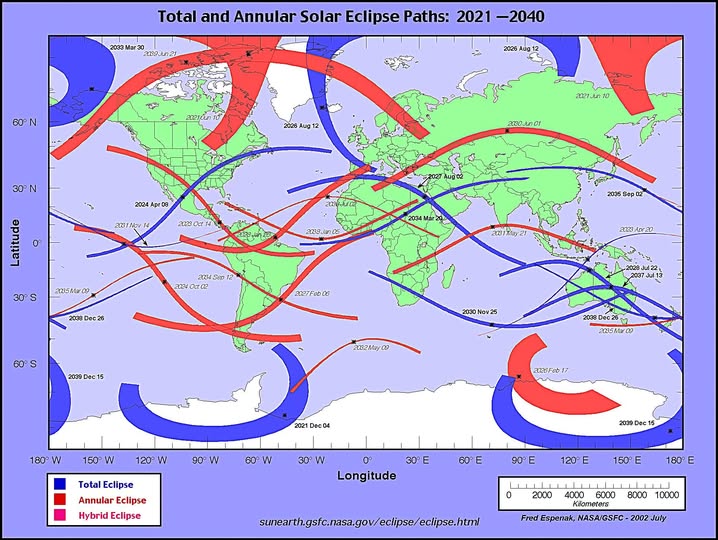
Map from NASA (Public domain)
If you have ever stood outside and watched the moon slide across the face of the sun, you already know there is nothing quite like a solar eclipse.
That eerie dimming of daylight, the sudden drop in temperature, and the crowd around you falling silent; it is one of nature’s most theatrical performances. And thanks to NASA, we now have a roadmap for every major show between 2021 and 2040.
What Are We Looking At?
This map, produced by NASA’s Fred Espenak, plots the paths of every total, annular, and hybrid solar eclipse across a 20-year window. Three types of eclipse appear here, each color-coded for easy reading.
Total eclipses (shown in blue) are the headline acts. The moon completely blocks the sun, plunging a narrow corridor of Earth into temporary darkness. These are the ones that make grown adults weep.
Annular eclipses (shown in red) occur when the moon is slightly farther from Earth in its orbit, so it appears a little smaller than the sun. Instead of full darkness, you get a blazing “ring of fire” effect around the moon’s silhouette.
Hybrid eclipses (shown in pink) are rare crossover events. Along different parts of the same path, the eclipse switches between total and annular. Witnessing one puts you in genuinely rare company.
Where Should Eclipse Chasers Be Heading?
The paths criss-cross the globe in sweeping diagonal bands, which tells you something important: no single continent owns eclipse season.
Europe and the North Atlantic get a stunning show on 12 August 2026. Australia and the South Pacific feature prominently in the 2030s. North America had its big moment in April 2024, but there are further opportunities ahead for the continent, particularly in the annular category.
The Southern Hemisphere sees real action too, with several paths cutting across the southern Indian and Pacific Oceans, plus notable tracks over Africa and southern South America.
Planning Your Next Eclipse Trip
The key takeaway from this map is that eclipse chasing is entirely achievable with reasonable planning. The paths are narrow, sometimes only a couple of hundred kilometres wide, so your exact location matters enormously.
Being just one hour’s drive outside the totality corridor turns a life-changing experience into a mildly interesting partial eclipse.
The Bottom Line
The universe runs on a remarkably predictable timetable, and this map hands you the programme notes. Whether you are a seasoned eclipse chaser or someone who simply wants to tick one extraordinary experience off your list, the next two decades offer plenty of opportunities. Pick your path, book early, and look up.
Help us out by sharing this map: