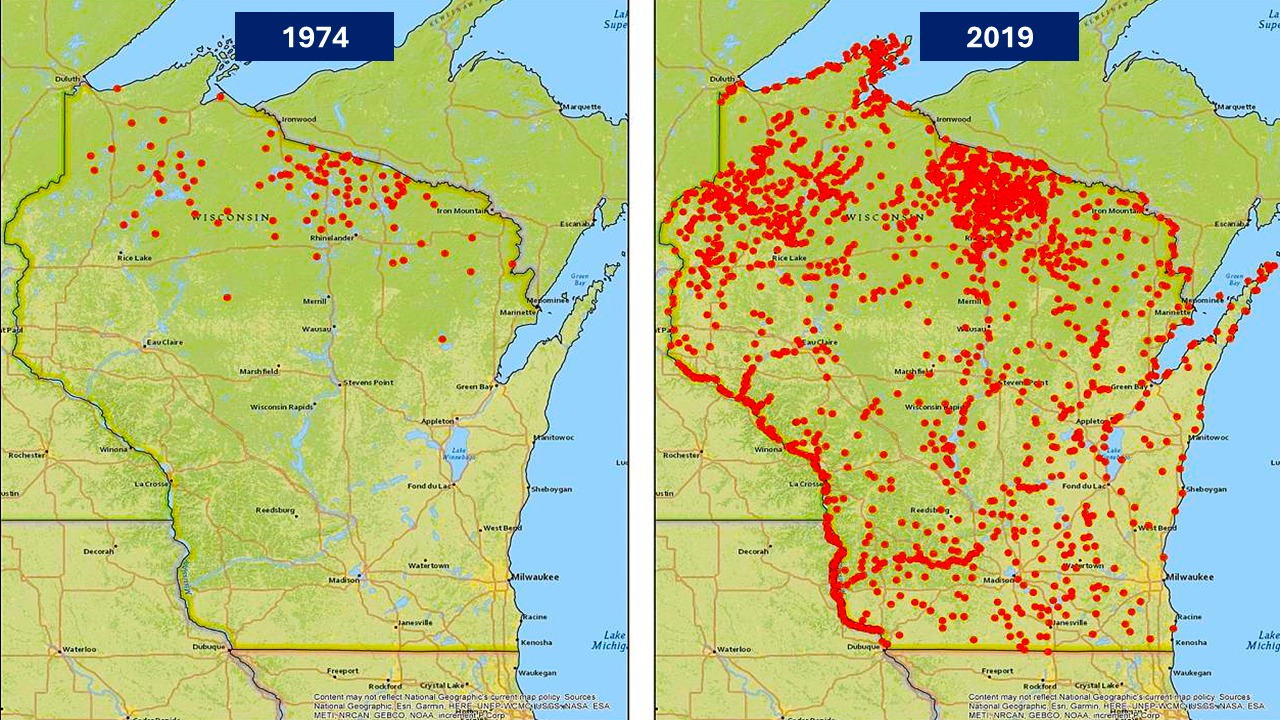
Map by the Wisconsin Department of Natural Resources
Looking at these two maps of Wisconsin tells one of America’s greatest conservation success stories.
In 1974, you could count the occupied bald eagle nests on your fingers and toes. Fast forward to 2019, and the state is practically dotted with red markers showing thriving eagle populations across nearly every county.
What Nearly Killed America’s Symbol
The near disappearance of bald eagles wasn’t due to hunting or habitat loss alone. The real culprit was DDT, a pesticide that seemed like a miracle chemical when it was first introduced.
Unfortunately, this “wonder drug” for pest control had a devastating side effect: it caused eagle eggshells to become so thin they would crack under the weight of nesting parents.
By the 1970s, there were only about 400 breeding pairs left in the entire lower 48 states. Wisconsin, once home to abundant eagle populations, had been reduced to just a handful of nesting pairs scattered across the northern regions.
The Clean Water Act Steps In
The Clean Water Act of 1972 became a game-changer, not just for water quality but for the entire ecosystem. By regulating what could be dumped into our waterways and controlling agricultural runoff, the act helped reduce the concentration of harmful chemicals like DDT in the food chain.
Eagles, being apex predators, had been getting concentrated doses of these toxins through the fish they ate. Cleaner water meant cleaner fish, which meant healthier eagles that could successfully reproduce again.
Beyond Water: A Team Effort
While the Clean Water Act laid the groundwork, the eagle recovery involved multiple strategies. The EPA banned DDT in 1972, and wildlife agencies began intensive breeding and reintroduction programs.
Wisconsin’s Department of Natural Resources worked with organizations across the Midwest to carefully monitor nests, protect breeding sites, and even relocate young eagles from areas with surplus populations.
The Numbers Tell the Story
The transformation is remarkable. From those scattered dozen or so nests in 1974, Wisconsin now hosts over 1,500 breeding pairs.
The recovery has been so successful that bald eagles were removed from the Endangered Species List in 2007, though they remain protected under other federal laws.
What This Means for All of Us
This success story shows what’s possible when we take environmental protection seriously. Clean water doesn’t just benefit eagles; it supports entire ecosystems, including the communities that depend on them. Wisconsin’s lakes and rivers are not only home to thriving wildlife but also support tourism, fishing, and recreation that contribute billions to the state’s economy.
The next time you see a bald eagle soaring overhead, remember that its presence is a testament to what we can accomplish when we commit to environmental stewardship.
Help us out by sharing this map:
You May Also Like:
If Indian States Were Countries: A Mind-Bending Population Comparison
America's Entire History Fits Inside One Trip Around the Sun: A Cosmic Perspective on Pluto's Orbit

Why Your European Friends Can Travel by Train While You're Stuck in U.S. Traffic
Which Animals Carry Rabies Near You? A Guide to North America's Rabies Variants

When Rome Ruled the World: A Journey Through History's Greatest Empire
When Did Your County Actually Exist? A Colourful History of Britain's Borders
Europe's Oldest Universities Map: Where They Still Thrive Today
