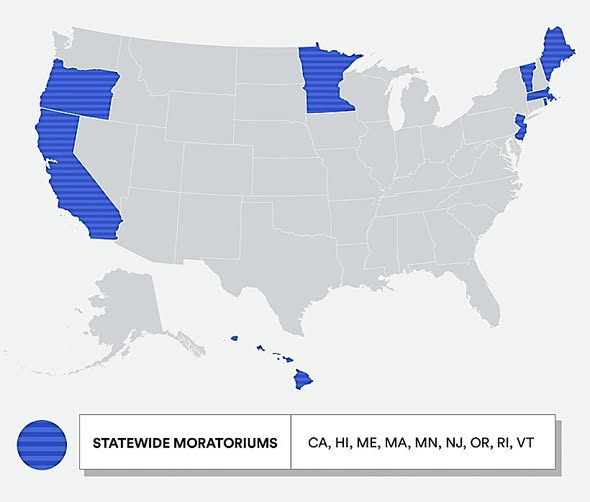
Map found on Reddit
As the United States debates its energy future with growing urgency, one underreported fact stands out: nine states have laws on the books that effectively ban the construction of new nuclear power plants.
The map above shows them in blue: California, Hawaii, Maine, Massachusetts, Minnesota, New Jersey, Oregon, Rhode Island, and Vermont.
At first glance, the pattern looks almost random. But dig a little deeper and a story emerges.
Where the Bans Came From
Most of these moratoriums were passed in the late 1970s and 1980s, in the anxious aftermath of Three Mile Island (1979) and, later, the Chernobyl disaster (1986).
State legislatures, responding to genuine public alarm, passed laws tying new nuclear construction to unresolved questions about waste disposal.
The legal logic was clever: rather than banning nuclear outright on safety grounds (which would have invited federal preemption), many states simply said no new plants could be built until the federal government established a permanent solution for storing spent nuclear fuel.
Since that solution still does not formally exist, the moratoriums technically remain in force.
The Geography of the Ban
The blue states cluster heavily on the two coasts, which tracks neatly with broader political geography. California and Oregon anchor the West Coast ban, while a dense cluster of northeastern states covers New England and the mid-Atlantic corridor.
Minnesota sits as the only inland outlier, a reminder that these decisions were driven by state politics as much as regional identity.
Hawaii is perhaps the most straightforward case: building nuclear infrastructure on a small volcanic island chain in the middle of the Pacific Ocean presents obvious logistical and geological complications beyond politics.
Why This Matters Right Now
Here is where it gets interesting. Nuclear energy is experiencing a remarkable rehabilitation in mainstream policy circles.
With climate targets growing more ambitious and the intermittency of wind and solar becoming harder to ignore, voices across the political spectrum are reconsidering fission. Advanced reactor designs, small modular reactors (SMRs), and next-generation safety systems have shifted the conversation considerably since 1979.
Several of the moratorium states are quietly revisiting their positions. California, which shuttered its last plant at Diablo Canyon in 2024 before reversing course and extending its life, is a case study in how rapidly the politics can shift when grid reliability comes under pressure.
The Waste Question Remains
Yet the original legal trigger for most of these bans, a permanent federal repository for nuclear waste, remains unresolved. Yucca Mountain in Nevada was the designated solution for decades before being effectively abandoned. Until that knot is untangled, the moratoriums in these nine states retain both their legal force and their political logic.
The blue patches on this map are not just history. They are an active constraint on America’s energy choices, at exactly the moment those choices matter most.
Help us out by sharing this map: