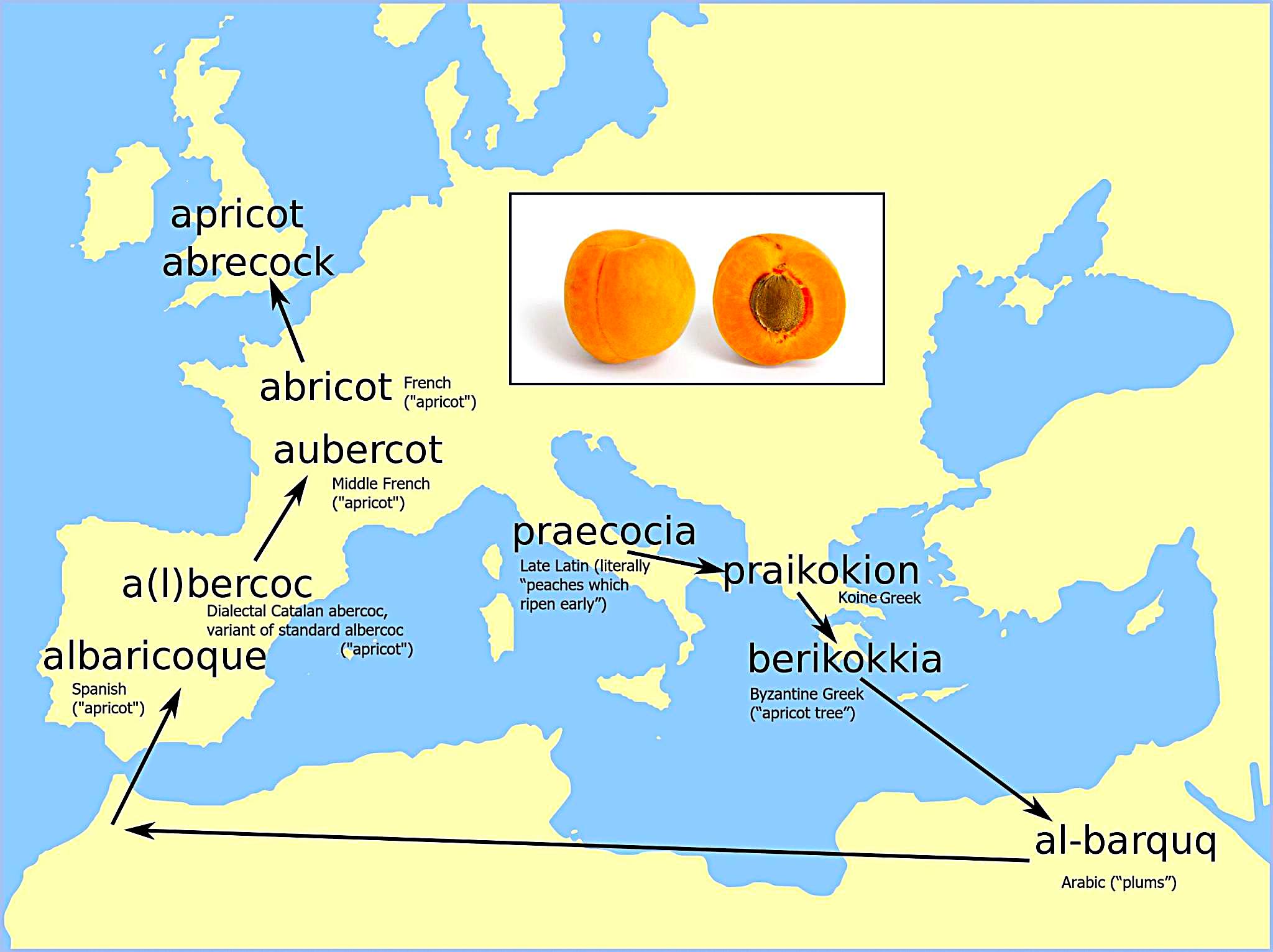
Map by Reddit user khokesh1996
Ever wondered why we call those delicious orange fruits “apricots”?
The story behind this simple word is actually a fascinating journey across continents, languages, and thousands of years of human trade and cultural exchange.
From Greek Gardens to Global Tables
The word “apricot” didn’t start its life in English. In fact, it began way back in ancient Greece with the word “praikokion” in Koine Greek.
The Greeks had a poetic way of describing these fruits, calling them “praecocia” in Late Latin, which literally meant “peaches which ripen early.” This makes perfect sense when you think about it: apricots do look like small peaches, and they ripen much earlier in the season.
The Mediterranean Migration
As the Roman Empire spread and trade routes connected distant lands, our little word began its epic journey westward. The Byzantines kept the Greek tradition alive with “berikokkia,” meaning “apricot tree.” But the real linguistic adventure happened when Arabic traders got involved.
The Arabs transformed the word into “al-barquq,” though interestingly, this Arabic term actually meant “plums.” This linguistic mix-up shows us how fluid language can be when cultures meet and trade goods across vast distances.
Spanish Shores and French Refinement
When the Moors brought the fruit and its name to Spain, “al-barquq” became “albaricoque.” You can still hear the Arabic influence in that Spanish pronunciation today.
Meanwhile, the French took a different approach, developing “abricot” from the earlier forms, which eventually gave us our modern English “apricot.”
The Northern Journey
The word continued its travels northward into other European languages. The Catalan dialect created “a(l)bercoc,” showing how regional variations kept sprouting up wherever the fruit and its name landed.
Each culture added its own linguistic fingerprint to this traveling word.
A Word That Connects Cultures
What makes this etymology particularly beautiful is how it reflects the interconnectedness of human civilization. From ancient Greek gardens to Arabic trade routes, from Spanish conquistadors to French markets, the word “apricot” carries within it the DNA of multiple cultures and languages.
Every time you bite into an apricot, you’re tasting not just a fruit, but thousands of years of human interaction, trade, and cultural exchange. The next time someone asks you about the origins of everyday words, you can tell them that sometimes the most ordinary things have the most extraordinary stories.
Help us out by sharing this map: