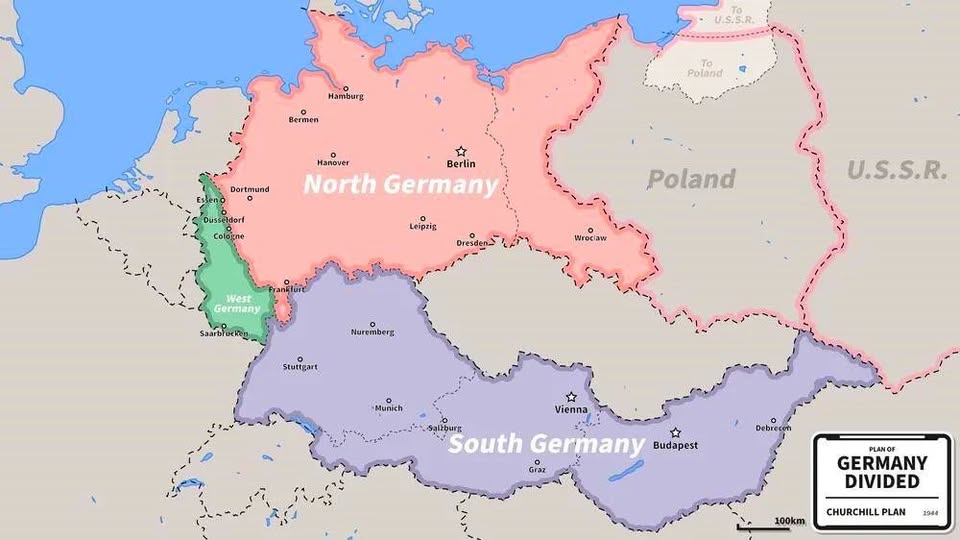
Map found on Reddit
Most of us learned about the two Germanys (East and West): the Cold War partition that shaped decades of history.
But tucked away in the archives of World War II diplomacy is a far more radical idea: Winston Churchill once proposed cutting Germany into three separate states. The map above illustrates exactly what that would have looked like.
The Churchill Plan, Explained
In 1944, with Allied victory increasingly inevitable, the Big Three powers (Churchill, Roosevelt, and Stalin) were already arguing over what post-war Europe should look like. Churchill floated a vision where Germany would be carved into three distinct entities.
North Germany would be the largest chunk, a pink expanse covering Berlin, Hamburg, Hanover, and stretching east toward what is now western Poland. Think of it as the Prussia-influenced heartland.
South Germany sits as a broad purple zone sweeping through Munich, Stuttgart, Vienna, and Budapest, essentially pulling in Austria and Hungary into a new southern bloc. This was partly Churchill’s idea of a revived Danubian confederation, a buffer zone against Soviet expansion.
West Germany is the small green sliver hugging the Rhine, covering industrial cities like Cologne, Düsseldorf, and Frankfurt. Compact but economically significant.
What Happened to the Eastern Territories?
Notice those dashed pink lines to the right of the map?
Large swathes of pre-war German territory were to be handed over to Poland and the USSR entirely. Regions including Silesia and East Prussia simply disappear from any version of “Germany” altogether. This actually did happen in reality, though within the two-state model we know.
Why It Never Happened
The Teheran and later Yalta conferences saw the Big Three agree on a four-zone occupation model instead, which eventually hardened into the familiar East/West split. The three-way division was considered too complex, and Stalin had his own very specific ideas about where Soviet influence should begin and end.
Churchill’s southern confederation idea was particularly contentious. The Soviets had no interest in a strong, independent bloc sitting on their western border.
Why This Map Still Fascinates Us
Alternative history maps like this one are genuinely useful thinking tools. They remind us that the world we live in was never inevitable. Borders, nations, and political identities are decisions made by exhausted men in smoky rooms, often under enormous pressure.
A three-way Germany might have produced a very different Cold War, a very different European Union, and a very different 21st century. Whether better or worse is anyone’s guess.
Next time someone tells you history was always going to turn out this way, show them this map.
Help us out by sharing this map: