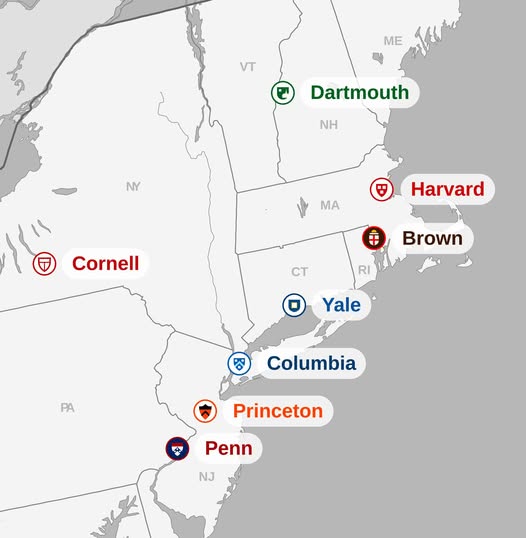
Map by Reddit user dphayteeyl
Looking at this map, it’s striking how clustered these eight legendary institutions are.
The Ivy League isn’t just an athletic conference – it’s a geographic phenomenon that tells the story of American higher education’s colonial roots.
New England’s Academic Powerhouses
The northern tier showcases some serious intellectual firepower.
Harvard sits in Cambridge, Massachusetts, casting its crimson shadow as America’s oldest university since 1636.
Just up the coast, Dartmouth holds court in New Hampshire’s scenic Hanover, while Yale anchors New Haven, Connecticut, with its Gothic revival architecture and secret societies.
Brown University rounds out New England from Providence, Rhode Island, known for its open curriculum and creative student body.
These four schools represent the birthplace of American academia, where revolutionary ideas literally helped birth a nation.
The Mid-Atlantic Academic Triangle
Moving south, we hit the power trio that forms higher education’s most competitive region.
Columbia University dominates Manhattan’s Upper West Side, offering students the unique combination of Ivy League prestige and New York City’s endless opportunities.
Princeton sits perfectly positioned in New Jersey, close enough to both New York and Philadelphia to attract top talent while maintaining its pristine campus bubble. The town literally grew around the university, creating that classic college town atmosphere.
Cornell University breaks the mold geographically, stretching up to Ithaca in New York’s Finger Lakes region. It’s the largest and most diverse of the Ivies, with its dramatic gorges and waterfalls creating one of America’s most beautiful campuses.
Finally, the University of Pennsylvania anchors Philadelphia, bringing urban grit to Ivy League sophistication with its powerhouse business school and medical programs.
Why Geography Matters
This clustering isn’t accidental.
These universities emerged in the colonial era when the Northeast was America’s population and economic center. They grew together, competed with each other, and eventually formalized their rivalry through athletics in 1954.
The concentration also creates a unique ecosystem where students, faculty, and resources flow between institutions. A Harvard professor might lecture at Yale, a Princeton graduate might pursue their PhD at Columbia, and research collaborations span the entire corridor.
Beyond the Prestige
While these eight schools represent academic excellence, their geographic concentration also highlights an important reality about American higher education. The Ivy League’s Northeast bias reflects historical advantages that continue to shape access to elite education today.
Whether you’re planning college visits or just curious about academic geography, this map reveals how proximity bred both competition and collaboration among America’s most storied institutions. From Hanover’s mountains to Manhattan’s skyscrapers, each location tells its own story within the larger Ivy League narrative.
Help us out by sharing this map: