Imagine losing your rubber duck in the bathtub and finding it in your neighbor’s yard 30 years later.
Now multiply that by 28,800 ducks, replace your bathtub with the Pacific Ocean, and your neighbor’s yard with beaches from Alaska to Scotland.
That’s exactly what happened when one of the most unexpected scientific studies in oceanographic history began with a simple cargo ship accident.
When Bath Time Goes Global
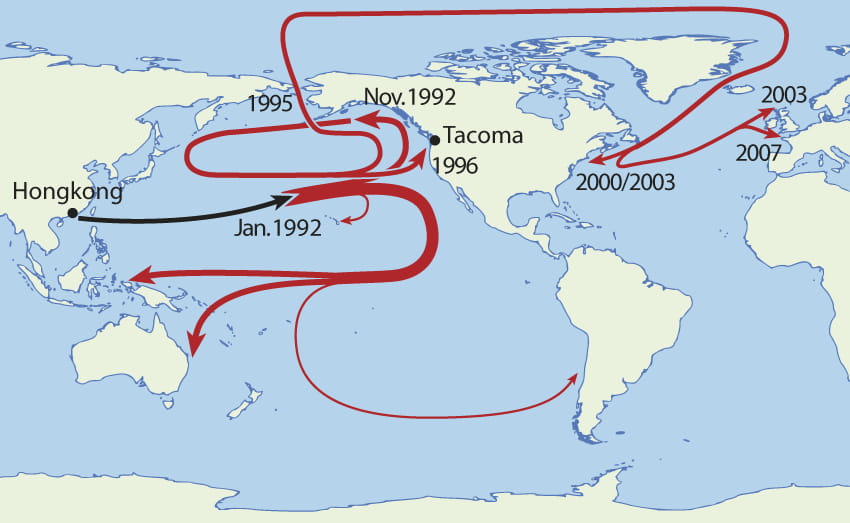
On January 10, 1992, the cargo ship Ever Laurel was traveling from Hong Kong to Tacoma when it encountered a massive storm in the North Pacific Ocean.
Hurricane-force winds and huge waves battered the 28,900-ton vessel, causing container stacks to snap loose from their moorings. Among the casualties? A shipment of 28,800 “Friendly Floatees” bath toys, including yellow ducks, red beavers, blue turtles, and green frogs, manufactured for The First Years toy company.
What seemed like a maritime disaster quickly became a scientific goldmine. Scientists could never ethically dump tens of thousands of plastic toys into the ocean, but this accidental release represented an opportunity too fortuitous to miss.
The floating army of bath toys was about to embark on the world’s most extensive and unintentional ocean current study.
The Scientist Who Followed the Ducks
Enter Curtis Ebbesmeyer, a retired oceanographer from Seattle who specialized in tracking ocean currents through flotsam movement.
Ebbesmeyer enlisted the help of beachcombers worldwide to track the toys’ movements, creating an unprecedented network of citizen scientists.
This wasn’t his first rodeo either; three years earlier, he had tracked about 61,000 Nike shoes that spilled from another cargo ship, using beachcomber reports to map their drift patterns along the West Coast.
Unlike traditional drift bottle studies that typically deploy fewer than 1,000 bottles with limited recovery rates, this bumper crop of 28,800 ocean current trackers promised to return significantly more data.
The Epic Journey Begins
The map reveals the incredible journey these toys took across the globe. The first discovery happened just ten months later in November 1992, when a beachcomber found ten toys near Sitka, Alaska, roughly 2,000 miles from their starting point. Hundreds more toys were eventually found along Alaska’s 530-mile shoreline.
But Alaska was just the beginning. Some toys traveled over 17,000 miles, floating over the site where the Titanic sank and spending years frozen in Arctic ice.
The toys have surfaced on shores across Australia, the Pacific Northwest, Hawaii, Alaska, South America, Scotland, and Newfoundland in the Atlantic.
More Than Just Floating Fun
This wasn’t merely an amusing story about wayward bath toys. Ebbesmeyer’s work with the Friendly Floatees helped validate and refine ocean current models, providing real-world data about how objects move through the world’s oceans. The study contributed valuable insights into:
- Pacific Ocean circulation patterns
- Arctic ice movement and seasonal changes
- Trans-oceanic current connections
- The behavior of floating debris in marine environments
The Legacy Continues
In 1996, Ebbesmeyer founded the Beachcombers’ and Oceanographers’ International Association, formalizing the network of citizen scientists who continue tracking marine debris.
While scientists now use advanced buoys to track oceanic movements, the rubber duck study remains a landmark example of turning an environmental accident into valuable scientific knowledge.
The next time you see a rubber duck, remember that thousands of its cousins are still out there somewhere, continuing their three-decade journey around the world’s oceans.
They’ve become floating ambassadors of science, proving that sometimes the most important discoveries come from the most unexpected places. Who knew that losing your bath toys could help unlock the secrets of our planet’s vast water systems?
Help us out by sharing this map: