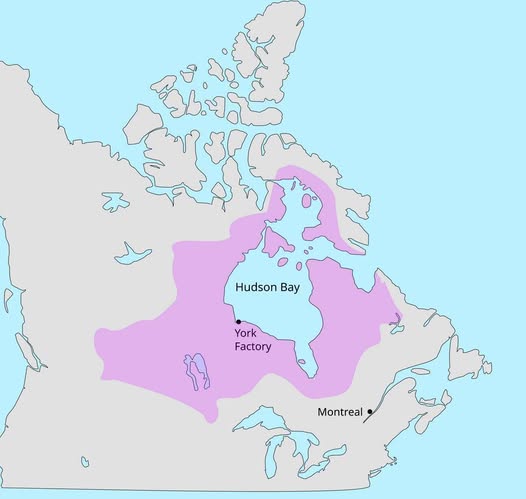
Map from Wikimedia Commons
Look at that pink blob on the map. It covers roughly 3.9 million square kilometers, an area larger than India, and for nearly 200 years it was essentially the private property of a single commercial enterprise: the Hudson’s Bay Company.
If you have ever bought a blanket at a Bay store in a Canadian mall, you have brushed up against one of the most extraordinary corporate land grabs in history.
What Exactly Was Rupert’s Land?
Rupert’s Land was not a country or a colony in the conventional sense. It was defined by hydrology: every river, stream, and lake whose waters ultimately drained into Hudson Bay fell within its boundaries. That is why the shape looks so organic and strange on a map. Nature drew the borders, not diplomats.
The territory was granted by royal charter to the Hudson’s Bay Company in 1670 by King Charles II, named after his cousin Prince Rupert of the Rhine, the company’s first governor. With a stroke of a pen, the Crown handed over sovereignty over land it had never seen, occupied by Indigenous peoples who had lived there for thousands of years.
York Factory: The Beating Heart of the Empire
The dot marked York Factory on the map might look insignificant, but it was once the most important piece of real estate in northern North America. Sitting at the mouth of the Hayes River on Hudson Bay’s western shore, it served as the main depot for the entire fur trade network.
Beaver pelts flowed in from thousands of kilometers away; trade goods flowed back out. At its peak, it was a bustling industrial complex of warehouses, workshops, and wharves, improbably planted in the subarctic wilderness.
Montreal: The Rival at the Edge
Notice that Montreal sits just outside the pink boundary. This was no accident. Montreal was the base of the rival North West Company, a scrappier, more aggressive outfit that pushed deep into the interior from the St. Lawrence side.
The tension between the two companies was fierce enough to occasionally turn violent, before they ultimately merged in 1821 under the Hudson’s Bay banner.
The End of the Monopoly
Rupert’s Land was transferred to the newly formed Dominion of Canada in 1870, a transaction so enormous it makes modern real estate deals look trivial. Canada paid £300,000 for it. Almost overnight, the vast pink expanse on this map became the foundation for the Prairie provinces and the Northwest Territories.
The Hudson’s Bay Company still exists today, though it has had a rocky few years. But the map above is a reminder that before it sold you a duvet, it once owned half a continent.
Help us out by sharing this map: