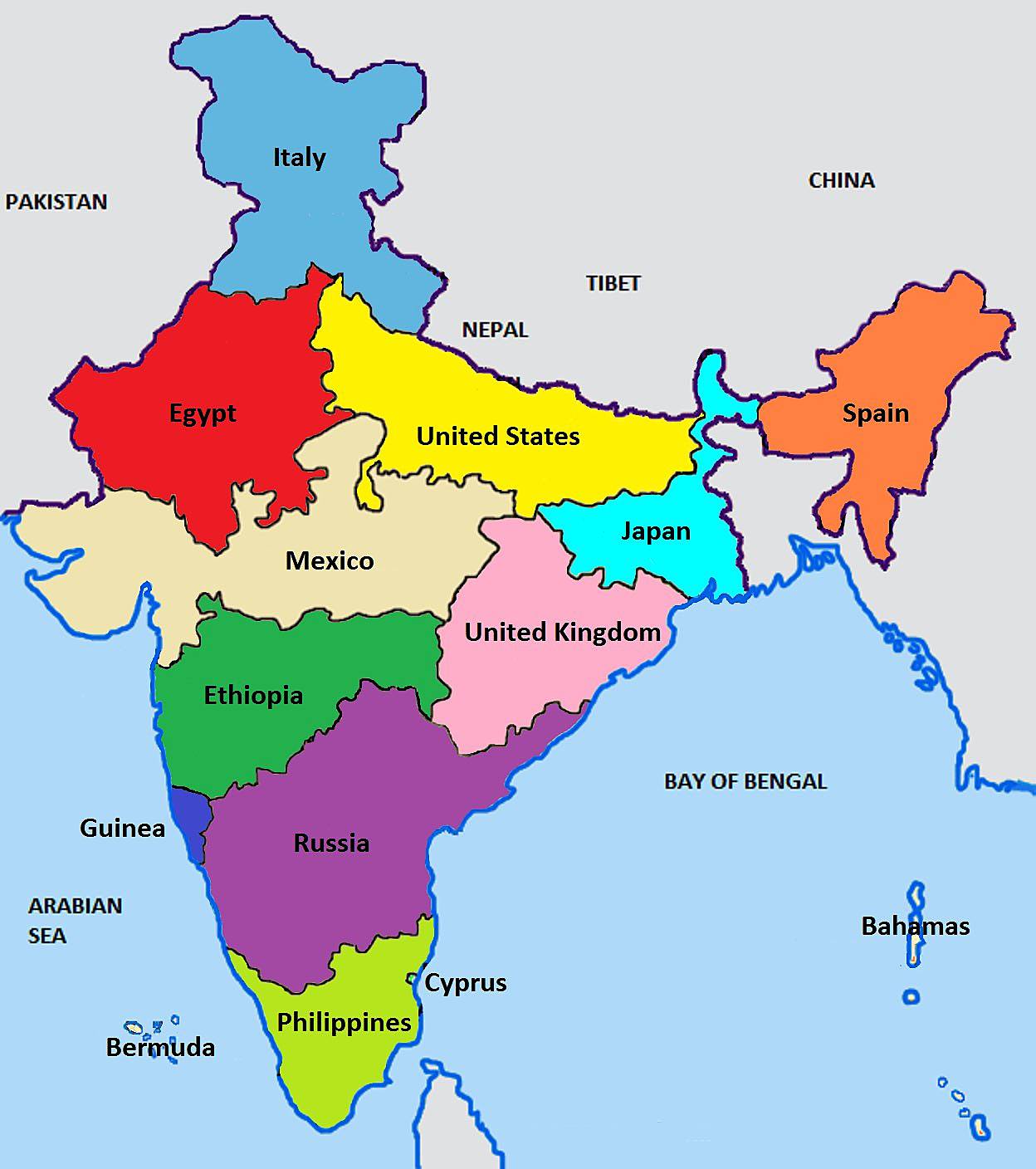
Map by Reddit user TheJaice
Imagine if someone told you that a single Indian state has more people than the entire continent of South America. Or that one region of India houses more souls than all of Russia, the world’s largest country by land area.
This fascinating visualization does exactly that by reimagining India’s states as countries with equivalent populations.
Size Doesn’t Always Equal People
The most striking revelation from this map is how our geographical assumptions crumble under demographic reality.
Take Uttar Pradesh, represented here as the United States. This single Indian state, roughly the size of Oregon, contains over 230 million people. That’s nearly 70% of the entire US population packed into a space that could fit into Texas twice over.
Similarly, Maharashtra appears as Ethiopia on this map, housing more than 100 million people. To put this in perspective, that’s more than the populations of Germany and Belgium combined, yet Maharashtra occupies less space than Poland.
The Demographic Giants Hidden in Plain Sight
What makes this visualization particularly eye-opening is seeing familiar countries transplanted onto Indian soil.
Russia, spanning eleven time zones and covering 17 million square kilometers, has fewer people than several individual Indian states. The entire United Kingdom, with its rich history and global influence, represents just a fraction of what some Indian states accommodate within their borders.
West Bengal, shown as Japan, demonstrates another fascinating parallel. Both regions are known for their cultural influence, technological advancement, and dense urban centers, yet West Bengal achieves this with a population spread across a much smaller geographic area.
Beyond the Numbers Game
This isn’t just about impressive statistics. These comparisons reveal the incredible logistical challenges India faces daily.
Imagine providing healthcare, education, and infrastructure to populations that rival entire continents. Every policy decision affects numbers that dwarf most nations on Earth.
The map also highlights India’s incredible diversity compressed into relatively compact spaces. Each colored region represents not just population numbers but entire worlds of languages, traditions, cuisines, and cultures living side by side.
A New Perspective on Global Demographics
This creative visualization forces us to reconsider our mental maps of the world. When we think about global population centers, we often focus on countries, but India’s states tell a different story. They remind us that some of the world’s most significant demographic and economic powerhouses exist not as nations but as sub-regions within a single country.
The next time you hear about policy changes or economic developments in Indian states, remember: you’re not just talking about regional news. You’re discussing developments that affect populations larger than most countries could ever imagine managing.
Help us out by sharing this map: