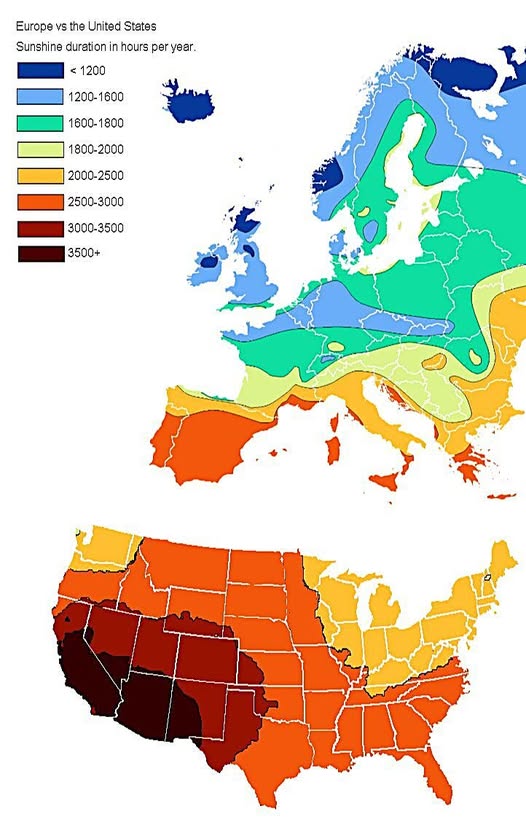
Map found on Reddit
If you have ever wondered why your Spanish friend seems effortlessly tanned while your colleague from Manchester looks like they have not seen daylight since 2019, this map holds the answer.
It shows annual sunshine duration in hours across both Europe and the United States, and the contrast is genuinely eye-opening.
Europe: A Continent of Extremes
Starting up north, Iceland, Scotland, and Scandinavia receive fewer than 1,200 hours of sunshine per year. To put that in perspective, that is barely three hours of sun on an average day. No wonder people in those regions celebrate every ray of light like it is a national holiday.
Move south through France and Germany, and things improve, reaching the 1,800 to 2,000-hour range. But the real sunshine jackpot in Europe sits around Spain, southern Italy, and Greece, where coastal areas clock between 2,500 and 3,000 hours annually. That Mediterranean lifestyle is not just a diet; it is powered by genuine, abundant sunlight.
The USA: Drenched in Sunshine
Now look at the lower map and the story shifts dramatically. Even the cloudiest corners of the American northwest are pulling in around 2,000 hours per year, roughly matching the sunniest parts of central Europe.
Head toward the southwest, and things get serious. Arizona, New Mexico, and parts of California and Nevada are deep into the 3,000 to 3,500+-hour bracket. These are places where the sun is not a pleasant surprise; it is simply a daily fixture.
What This Actually Means Day to Day
More sunshine hours translate into real lifestyle differences:
Energy costs drop as solar panels become far more viable across most of the US compared to northern Europe.
Health outcomes shift too, since vitamin D deficiency is significantly more common in northern European populations.
Tourism patterns make a lot more sense when you realise that millions of northern Europeans fly south every summer essentially chasing the same sunlight that most Americans step outside to find in their own backyard.
The Takeaway
This map is a neat reminder that geography shapes daily life in ways we rarely stop to think about. A person growing up in Seattle or Portland is actually experiencing sunlight levels comparable to central France, while someone raised in Phoenix is living under conditions closer to the Saharan fringe of North Africa.
Next time you hear a European wax lyrical about a holiday in Spain, remember: they are not being dramatic. For much of the year, that sunshine genuinely is a rare and precious thing. For most Americans, it is just a Tuesday.
Help us out by sharing this map: