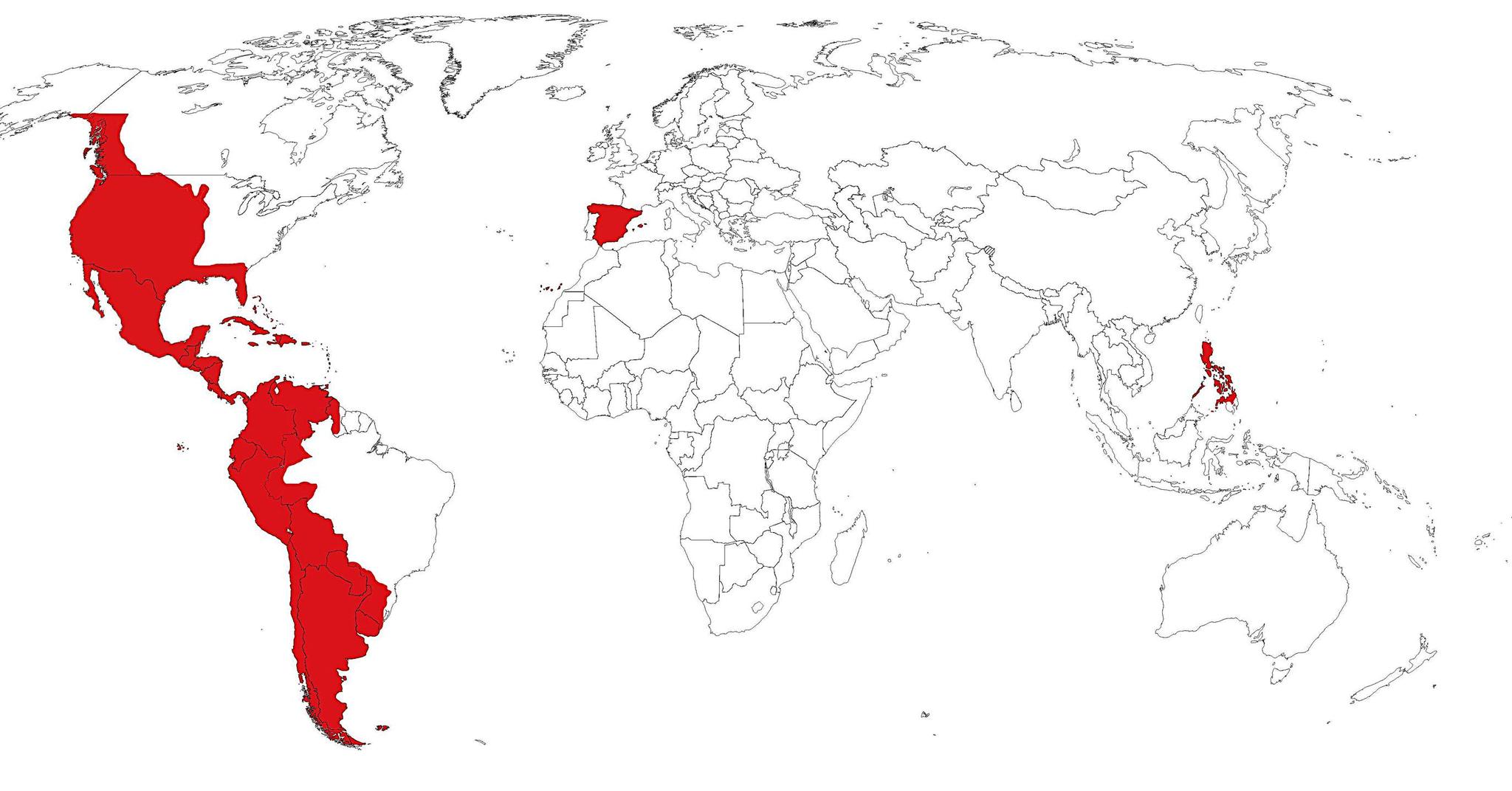
Map by Reddit user Homesanto
Picture this: it’s 1790, and if you were to sail from Madrid with a Spanish passport, you could travel to four different continents without ever leaving Spanish territory.
At its peak, the Spanish Empire was the largest empire in human history, stretching across roughly 13.7 million square kilometers and controlling about 25% of the world’s landmass.
The Sun Never Set on Spanish Soil
The phrase “the empire on which the sun never sets” is often associated with the British Empire, but Spain earned this distinction first.
From the silver mines of Potosí in Bolivia to the trading ports of the Philippines, Spanish influence wrapped around the globe like an enormous colonial embrace.
In 1790, Spain’s territorial reach was staggering. The empire included most of South America (except Portuguese Brazil and the Guianas), Central America, Mexico, much of the western United States, Florida, numerous Caribbean islands, the Philippines, and several Pacific islands.
This wasn’t just about planting flags either; these were functioning colonies with established governments, trade networks, and cultural exchange systems.
The Americas: Spain’s Crown Jewel
The backbone of Spanish imperial power lay in the Americas.
The Viceroyalties of New Spain, Peru, New Granada, and Río de la Plata formed the administrative heart of this vast network. Mexico City and Lima became some of the world’s most important cities, rivaling European capitals in wealth and influence.
Spanish America wasn’t just about gold and silver extraction, though those precious metals certainly fueled European economies for centuries. The empire facilitated the exchange of crops, animals, and ideas between continents.
Potatoes, tomatoes, and chocolate traveled from the Americas to Europe, while horses, cattle, and wheat made the journey westward.
Beyond the Americas: Pacific Ambitions
Spain’s Pacific presence often gets overshadowed by its American territories, but the Philippines represented a crucial link in global trade.
The Manila Galleon trade route connected Asian silk and spices with American silver, creating one of history’s first truly global supply chains.
The Beginning of the End
By 1790, cracks were already showing in the imperial foundation. The American Revolution had demonstrated that European colonies could successfully break free, and Enlightenment ideas about self-governance were spreading throughout Spanish America.
Within three decades, most of Spanish America would gain independence, leaving Spain with only Cuba, Puerto Rico, and the Philippines.
A Legacy That Shaped the World
The Spanish Empire’s influence extends far beyond political boundaries. Today, over 500 million people speak Spanish worldwide, Catholic Christianity dominates much of Latin America, and Spanish colonial architecture still defines city centers from Mexico to Argentina.
Understanding the scope of the 1790 Spanish Empire helps explain everything from modern linguistic patterns to contemporary geopolitical relationships. It reminds us that for nearly three centuries, Spain wasn’t just a European power but truly a global superpower that shaped our interconnected world.
Help us out by sharing this map: