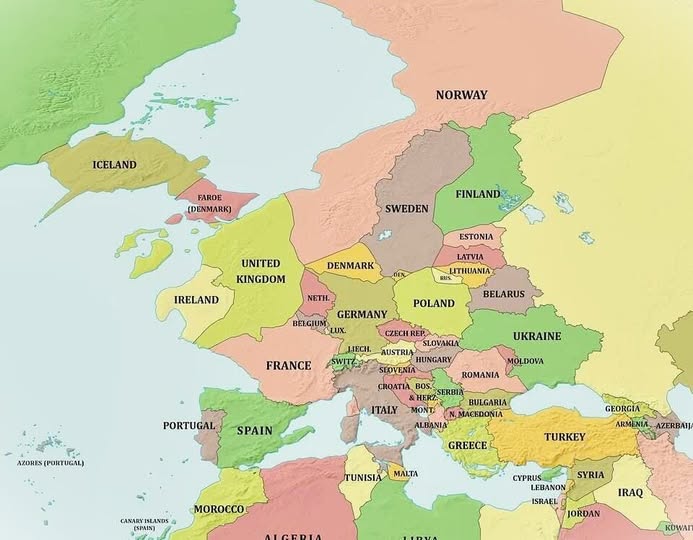
Map found on Reddit
Forget rising sea levels for a moment. What if we ran the film in reverse, dramatically, dropping global sea levels by a full 1,000 meters? The map above shows exactly that, applied to Europe, and the results are genuinely jaw-dropping.
Coastlines dissolve outward, seas shrink to lakes, and the continent becomes almost unrecognizable. It is the kind of geographic thought experiment that reminds you how much of our familiar world is simply water sitting in a bowl.
The North Sea Practically Disappears
One of the most dramatic changes is in the north. The shallow North Sea, which today separates Britain from continental Europe, essentially vanishes.
The United Kingdom is no longer an island. England connects directly to the Netherlands, Belgium, and Denmark across what geologists call Doggerland, a real landmass that actually existed during the last Ice Age when sea levels were far lower than today. Britain being an island is, in deep geological time, a fairly recent development.
Denmark, meanwhile, expands considerably, and the Baltic Sea shrinks into a large inland lake. The Scandinavian peninsula grows outward at its edges, though Norway and Sweden remain largely recognizable given their mountainous terrain.
The Mediterranean Transforms
Further south, the changes are equally striking.
The Mediterranean Sea narrows dramatically. The Adriatic, which today separates Italy from the Balkans, largely disappears, meaning Italy connects overland to Croatia and Slovenia. The islands of the Mediterranean, Malta, Cyprus, and others, either grow dramatically in size or merge with nearby landmasses entirely.
The Aegean, currently dotted with Greek islands, consolidates into a much smaller body of water, effectively making Greece substantially larger and connecting many of today’s islands to the mainland.
Iceland Gets Bigger, and Gains Neighbors
Up in the North Atlantic, Iceland expands considerably, its underwater shelf becoming dry land.
More remarkably, the mid-Atlantic Ridge that Iceland sits on begins to reveal more of itself, hinting at a chain of elevated terrain stretching across what we currently think of as open ocean.
What This Tells Us About Geography
The deeper lesson here is that our mental map of Europe is just a snapshot, one particular moment in a planet that has looked radically different many times before. Sea levels have swung by hundreds of meters across geological history, and the shapes we consider permanent are anything but.
Europe as we know it, with the English Channel, the Adriatic, the Aegean, is a coastline drawn in the relatively recent past. Drop the ocean far enough and the continent becomes a very different place, one that would have rewritten history, trade routes, invasions, and civilizations entirely.
Geography, it turns out, is just geology in slow motion.
Help us out by sharing this map: