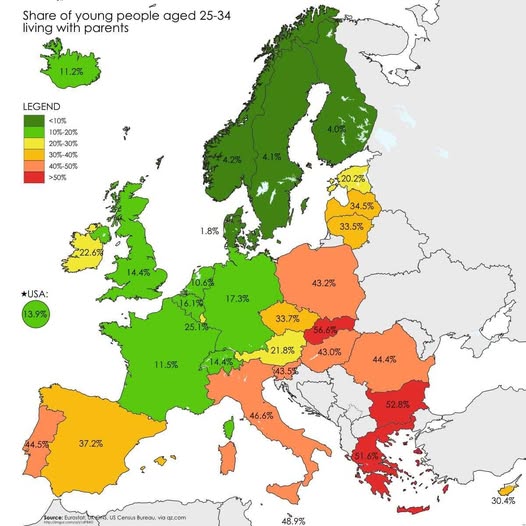
Map found on Reddit
You have probably scrolled past a dozen hot takes today, so here is something genuinely interesting: a snapshot of how many young Europeans aged 25 to 34 are still living under their parents’ roof.
The numbers range from surprisingly low to jaw-dropping, and the geography tells a fascinating story about economics, culture, and the cost of modern life.
The North vs South Divide Is Very Real
Scandinavia is doing its own thing, as usual. Iceland comes in at just 11.2%, Norway and Sweden hover around 4%, and Denmark sits at a cool 1.8%. If you are 28 and renting your own apartment in Copenhagen, you are very much the norm.
Head south, and the picture flips dramatically. Greece tops the chart at 81.6% in one region, with Croatia at 56.6%, Serbia at 52.8%, and Italy’s southern regions pushing close to 49%.
These are not outliers; they represent a broad Mediterranean pattern where multi-generational living is both a financial necessity and a deeply ingrained cultural expectation.
What Is Actually Driving This?
Three big forces are at play here.
Housing costs and wages. In Southern and Eastern Europe, stagnant wages and expensive urban rents make independent living genuinely difficult for young people, not a lifestyle choice.
Youth unemployment. Countries that were hit hardest by the 2008 financial crisis and subsequent austerity, particularly Greece, Italy, and Spain, still carry elevated youth unemployment rates that make saving a deposit feel like a fantasy.
Cultural attitudes. In many Mediterranean and Balkan cultures, living with parents well into adulthood carries zero social stigma. Family is the primary social unit, and leaving early can even be viewed as slightly odd.
The Middle Ground Is Interesting Too
France, Germany, and the UK cluster in the 10 to 25% range, reflecting a mix of better housing policy, stronger graduate job markets, and a cultural lean toward independence.
Poland and the Baltic states sit in an intriguing middle band, around 20 to 35%, reflecting rapid economic modernisation that has not yet fully translated into affordable independent living for everyone.
The Bigger Picture
This map is not really about laziness or ambition. It is a mirror held up to housing policy, wage growth, and what each society has decided to prioritize. The Nordic countries have invested heavily in affordable housing and strong graduate employment. Others have not, and young people are making rational decisions based on the options in front of them.
So next time someone jokes about a 30-year-old living at home, maybe check which country they are from first.
Help us out by sharing this map: